You’ve written the letter. Sealed the envelope. And now you’re staring at the blank front wondering exactly where everything goes — and whether getting it wrong means it never arrives.
It’s one of those things nobody officially teaches you. School doesn’t cover it. Most guides assume you already know the basics and skip straight to edge cases. So you end up guessing, or copying someone else’s envelope and hoping for the best.
Knowing how to write address on envelope properly isn’t complicated — but the details matter more than most people realize. The wrong line order, a missing apartment number, or a misplaced country name can send your letter on a detour that ends at a sorting facility instead of a doorstep.
By the end of this guide, you’ll know the exact format for every situation: standard domestic mail, international post, job applications, business envelopes, apartments, and couples. No guessing. No returns.
The format is simple. Getting it right every time just takes knowing the rules once.
Table of Contents
The Anatomy of an Envelope: What Goes Where
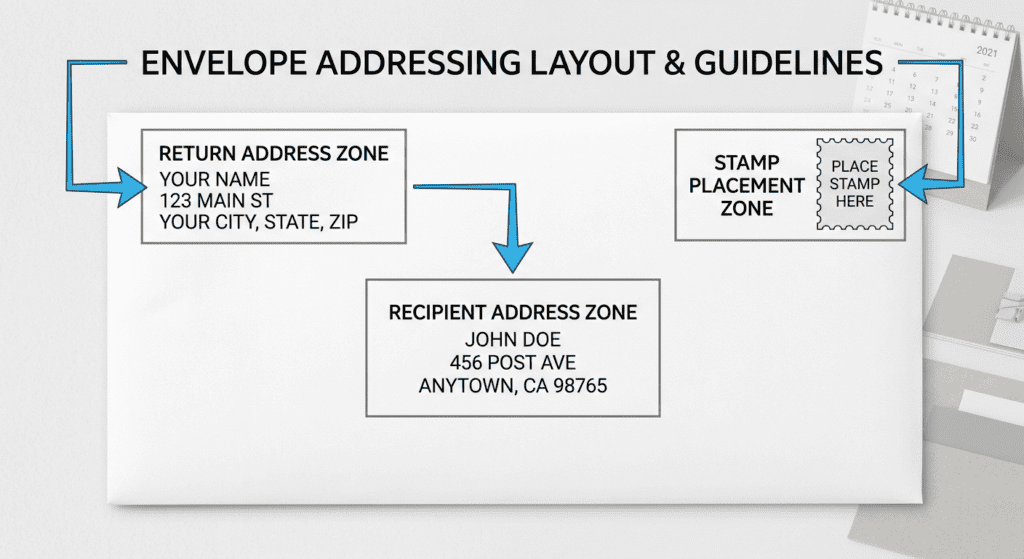
Before anything else, understand that an envelope has three zones — and each one has a job.
The return address lives in the top-left corner. This is your address: the sender. It tells the postal service where to send the letter back if delivery fails. Skipping it is a gamble you usually lose.
The recipient address sits centered on the front of the envelope — slightly below the midpoint, horizontally centered. This is where the postal service’s eyes go first, so clarity here is everything.
The postage stamp goes in the top-right corner. This one most people get right instinctively.
According to Royal Mail’s addressing guidelines, addresses that follow the correct format are processed faster and with fewer errors by automated sorting machines. The machines read from the bottom up — so the postal code on the last line is actually the first thing they scan.
That last detail changes how you think about formatting. The postal code isn’t an afterthought. It’s the anchor.
How to Write the Recipient’s Address: The Standard Format
This is the format that covers the majority of letters — domestic mail sent within one country.
Write the recipient’s address in this order, each element on its own line:
- Full name — first and last, or title and surname for formal mail (e.g., Mr. James Carter)
- Street address — house number and street name (e.g., 42 Maple Street)
- Apartment or unit number — if applicable, on the same line or directly below (more on this shortly)
- City or town
- State, province, or county — abbreviated where standard (e.g., CA for California, or simply the county name in the UK)
- Postal code or ZIP code — on the same line as the city/state, or below it depending on the country
- Country name — only needed for international mail; write it in capital letters on the last line
Key Insight: Every line should be left-aligned within the address block. Don’t center individual lines — center the entire block on the envelope. These are two different things, and mixing them up is one of the most common formatting mistakes.
How to Write an Address on Envelope With an Apartment Number
And that’s where most people get stuck. Apartments, units, flats, suites — there are multiple ways to handle them, and the wrong format can cause delays.
The safest approach: include the apartment number on the same line as the street address, after the street name.
Example: Sarah Mitchell 27 Linden Avenue, Apt 4B Austin, TX 78701
If the line gets too long, put the apartment number on a separate line directly above the street address — not below it. Postal systems in the US, UK, and most of Europe read from the bottom of the address block upward, so putting the apartment below the street can confuse automated sorting.
Alternative format (long addresses): Sarah Mitchell Apt 4B 27 Linden Avenue Austin, TX 78701
Pro Tip: Avoid writing “Apartment” in full if the line is already long. Standard abbreviations — Apt, Unit, Ste, Fl — are universally understood and keep the address clean.
[Image: Side-by-side example showing correct apartment address format on an envelope versus an incorrectly formatted version with the unit number on the wrong line]
How to Address an Envelope for a Job Application
A job application envelope is a specific context — and it signals more than just a delivery address. The way you format it communicates professionalism before the letter is even opened.
Here’s what changes compared to a standard letter:
Use the full formal name and title. If you’re sending to a hiring manager whose name you know, use it. “Ms. Rachel Okonkwo, Hiring Manager” tells the mailroom exactly where this should go and shows you did your homework.
Include the department if you know it. Add it as a separate line directly below the name:
Rachel Okonkwo Hiring Manager, Human Resources Brightwell Consulting Ltd 14 Commerce Square London EC2V 8RF
If you don’t know the name, use a role-based addressee:
The Hiring Manager Brightwell Consulting Ltd 14 Commerce Square London EC2V 8RF
Write “Private and Confidential” in the top-left corner of the envelope, above your return address. This isn’t just etiquette — it signals that the envelope shouldn’t be opened by anyone other than the intended recipient, which matters in large organizations.
Important: Never write “Job Application” or “CV Enclosed” on the outside of an envelope. It seems helpful. It actually flags the envelope for lower priority handling in some organizations, and it eliminates any chance of your application being routed directly to the decision-maker before it’s been pre-screened.
How to Write an International Address on Envelope
International mail follows the same basic structure, but with one critical rule: always write the destination country in capital letters on the very last line. Not abbreviated. Not in your language. In the language of the destination country or in English — both are acceptable.
The format for most countries looks like this:
Recipient Name Street Address City / Postal Code COUNTRY NAME
Here’s a real-world example of how to write an address on an envelope for international post — sending from the UK to Germany:
Hans Bergmann Unter den Linden 42 10117 Berlin GERMANY
A few country-specific notes worth knowing:
- United States: The city, two-letter state abbreviation, and ZIP code all go on the same line (e.g., Chicago, IL 60601).
- Japan: Addresses are written in reverse order (largest to smallest: prefecture, city, ward, street) — if addressing in English for international delivery, use the Western order.
- Canada: The province abbreviation and postal code go on the same line as the city (e.g., Toronto, ON M5H 2N2).
- Australia: City and state go on the same line, with the postcode at the end (e.g., Melbourne VIC 3000).
Key Insight: The Universal Postal Union — the UN agency that coordinates international postal services — recommends writing the country name in the language of the sending country OR in English. Either is accepted worldwide. What matters is that it’s legible, in capitals, and on its own line.
The edge case worth knowing: Some countries process mail through a national hub before distributing it locally. In those cases, an incorrectly formatted country name doesn’t just delay delivery — it can route the letter to the wrong hub entirely.
How to Address an Envelope to a Married Couple
This one trips people up because there are actually several correct options, and the “right” choice depends on context — formal vs. casual, whether both names are known, whether one or both have changed their surname.
Here’s a breakdown:
| Situation | Format |
|---|---|
| Traditional / Formal | Mr. and Mrs. James Carter |
| Both names (formal) | Mr. James Carter and Mrs. Laura Carter |
| Different surnames | Mr. James Carter and Ms. Laura Singh |
| Same-sex couple (formal) | Mr. and Mr. James and Oliver Carter |
| Casual / informal | James and Laura Carter |
| One name unknown | Mr. James Carter and Guest |
Pro Tip: When both people have professional titles — two doctors, for instance — write both titles. “Dr. James Carter and Dr. Laura Carter” is always correct. Omitting one title when the other is used can come across as dismissive.
If the couple has hyphenated or retained separate surnames, write both surnames. “The Carter-Singh Family” works for less formal envelopes, but for anything official, spell out both full names.
The rule that simplifies every variation: when in doubt, use full names and skip the gendered titles entirely. “James Carter and Laura Singh” is correct, inclusive, and readable — and it works in every context.
How to Address a Business Envelope
Business envelopes follow a stricter format than personal mail — and for good reason. In a company that receives dozens of letters daily, a poorly addressed envelope can sit in a general mailbox for days.
The correct order for a business address:
- Recipient’s full name and title (e.g., Ms. Priya Sharma, Director of Operations)
- Company name (on the line directly below the name)
- Building number and street
- Floor or suite number, if applicable
- City
- State/County/Province
- Postal code
- Country (for international mail only)
Example:
Ms. Priya Sharma Director of Operations Nexora Solutions Inc. Suite 800, 350 Bay Street Toronto, ON M5H 2S6 CANADA
If you’re sending to a company without a named recipient — for example, a general inquiry — address it to the relevant department:
Accounts Receivable Department Nexora Solutions Inc. Suite 800, 350 Bay Street Toronto, ON M5H 2S6
Note: For large corporations, including the floor or suite number isn’t optional — it’s essential. Mail rooms in office towers sort by suite or floor before they sort by name. Without it, your letter enters a slow-moving general queue.
The Return Address: Why You Should Never Skip It
Most people treat the return address as a formality. It’s not.
The return address is your safety net. If the letter can’t be delivered — wrong address, recipient moved, insufficient postage — the postal service needs somewhere to send it back. Without a return address, your letter disappears. No notification. No recovery.
Write your return address in the top-left corner of the front of the envelope. Use the same format as a recipient address — name, street, city, postal code — but keep it slightly smaller than the recipient address to avoid visual confusion.
For formal or business mail, some people write the return address on the back flap of the envelope instead. Both placements are accepted by postal services worldwide, but the top-left front is recommended for anything being sent internationally, since back-flap addresses can be missed by automated scanners.
Format:
Your Name 123 Your Street Your City, State 00000
Simple. Small. But it’s the difference between getting a failed delivery notification and never knowing what happened to your letter.
Common Addressing Mistakes That Get Letters Returned
These aren’t edge cases. They happen constantly — and every one of them is avoidable.
- Writing the postal code on the wrong line. The postal code must be on the last line of the address (before the country). Putting it mid-address breaks automated sorting.
- Using informal abbreviations postal systems don’t recognize. “St.” for street is fine. Inventing your own shorthand is not.
- Forgetting the apartment number entirely. If someone lives in a building with multiple units, the letter ends up with the building manager — or in a communal mailbox — and may never reach the right person.
- Writing the country in lowercase or abbreviated form. Always capitalize the full country name on its own line. “UK” or “usa” doesn’t work reliably with all postal systems.
- Centering individual lines instead of the address block. Each line should be left-aligned. The entire block should be centered on the envelope — not each line independently.
- Using pencil. Postal processing equipment — conveyor belts, rubber rollers, scanning machines — regularly smears pencil. Always use a pen or print the label.
Key Insight: According to postal research, the single most common cause of undeliverable mail isn’t a missing street — it’s a missing or incorrect postal code. The code is what the sorting machine reads first. Everything else is for the human delivery carrier.
What is the correct order for writing an address on an envelope?
Where does the return address go on an envelope?
How do I write an address on an envelope going to another country?
How do I address an envelope to a married couple with different last names?
Do I need to write my return address on every envelope?
How do I write an apartment number in an address on an envelope?
Is there a difference between addressing a business envelope and a personal one?
Three things matter most when addressing an envelope: the postal code goes last (it’s the first thing machines read), the apartment number belongs on or above the street line (never below), and the return address in the top-left isn’t optional — it’s your only way to recover a failed delivery.
Get those three right and you’ll handle almost every situation: domestic letters, international post, job applications, business mail, and envelopes addressed to couples.
The format feels trivial until something doesn’t arrive. Now you know exactly why it matters — and how to get it right every time.
For more practical guides that skip the filler and get straight to what works, explore tools and tutorials at Geniostack.com.