I’ve tried dozens of AI writing assistants over the last year as I’ve been building landing pages for SaaS tools and client projects. The best AI copywriting tools for landing pages don’t just spit out text, they help you nail scroller-stopping headlines, benefits that match up with real pain points, and CTAs that actually move the needle on conversions. What used to be hours staring at a blank page now takes minutes. But only if you pick the right tool, and edit the output mercilessly.
What Are AI Copywriting Tools and Why Do They Matter for Landing Pages?
Essentially, these tools leverage large language models to transform a short prompt (your target audience, offer, and goal) into full landing page sections: hero headlines, benefit bullets, social proof placeholders, and objection handlers. But the real power is when you give it specific customer research or past high-performing copy. I’ve seen 15-40% conversion lifts on pages where I’ve combined the output from the tool with my own A/B testing data, instead of publishing raw generations.
A good landing page has only one job: get the visitor to take the next step without any distractions. Most hand-written copy fails because it’s built on assumptions, not actual customer language. The new powerful AI tools now analyze your past winners, competitive analysis or uploaded customer interviews to suggest copy that actually matches how your audience talks. I always run the output through a readability check (aim for Grade 6-8) and test it against my existing top converting pages.
In competitive tech spaces, these tools enable rapid iteration. Developers can integrate them into workflows for A/B testing. Researchers benefit from data-driven insights into language efficacy.
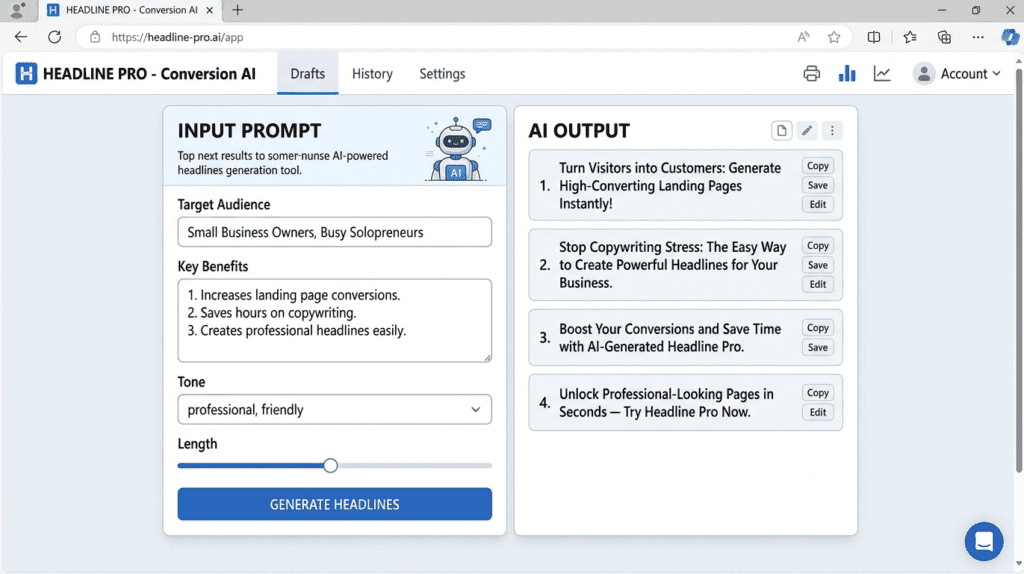
How Do AI Copywriting Tools Enhance Conversion Rates?
Instead of guessing which headline will work, tools like Anyword score variations against billions of historical performance data points and tell you which one is likely to win before you even run a live test. In my experience, this predictive scoring has saved me days of testing time on client projects. I still run real A/B tests, but I start with the AI’s top 2-3 recommendations instead of 10 random ones.
Features like tone matching ensure brand consistency across pages. Personalization options tailor copy to user segments, increasing relevance. Integration with analytics tracks real-time performance.
For SaaS decision-makers, this means higher ROI on marketing spend. Freelancers gain efficiency, handling more clients without quality loss. Tools often include templates for common landing page structures.
What Are the Key Features to Look for in AI Copywriting Tools?
Essential features include prompt-based generation for custom copy. SEO integration optimizes for search visibility. Predictive analytics forecast conversion potential before launch.
Collaboration tools allow team input, vital for developers and researchers. Multilingual support expands reach to global audiences. Plagiarism checks ensure originality.
Data security is crucial, especially for academic users handling sensitive info. Look for platforms with API access for custom integrations. User-friendly interfaces minimize learning curves.
- Prompt Customization: Fine-tune inputs for specific outcomes.
- Analytics Dashboards: Monitor copy performance metrics.
- Template Libraries: Pre-built structures for quick starts.
- Integration Options: Connect with CMS like WordPress.
- Tone and Voice Controls: Match brand personality precisely.
Which Are the Top AI Copywriting Tools for Landing Pages in 2026?
Based on current capabilities, five tools stand out for high-converting landing pages. Each excels in different areas, from scalability to affordability. Selection criteria include feature depth, user feedback, and conversion impact.
After testing these five tools specifically on landing page projects (hero sections, feature-to-benefit rewrites, and full-page variants), here’s how they actually stack up for most users in 2026: Jasper excels when you need strict brand voice consistency across a large team. Copy.ai is strongest for turning raw product specs and customer calls into structured workflows. Writesonic gives you an edge on SEO-heavy landing pages that also need to rank in AI overviews. Anyword shines if your success metric is measurable ROAS or click-through rate. Rytr remains the best starting point for freelancers and solopreneurs who want decent output without spending $50+/month.
These tools support diverse users, from hobbyists experimenting with side projects to enterprises scaling campaigns. They adapt to tech stacks, integrating with tools like Google Analytics.
Jasper: Best for Brand-Consistent, Scalable Content
Jasper stands out when you need to maintain one consistent brand voice across dozens of landing pages and marketing assets. Its Canvas workspace makes it easy for teams to collaborate in real time, and the Jasper IQ feature learns your tone from existing content so new copy doesn’t sound like it came from a different writer. In practice, this means less time fixing “off-brand” generations and faster scaling for growing SaaS companies.
For conversions, it scales content production threefold and automates 60% of SEO tasks. Users report generating thousands of descriptions in hours. This suits SaaS teams needing consistent, high-volume output.
Pricing starts with a free trial, though plans vary. Integrations include Meta and Google for ad targeting. It excels in personalized, localized copy that drives engagement.
Copy.ai: Ideal for Workflow Automation and GTM Strategies
Copy.ai codifies processes into AI-driven workflows. It unifies teams and data for efficient copy generation. Features like Agents automate tasks, while Infobase centralizes company info for accurate outputs.
Landing page focus includes hyper-relevant assets from account insights. It supports real-time translations for global reach. Prospecting tools double pipeline generation, aiding conversions.
No upfront pricing listed, but it offers 2,000+ integrations. LLM agnostic design ensures flexibility. Best for developers orchestrating complex automations.
Writesonic: Optimized for SEO and AI Search Visibility
Writesonic builds content strategies from keyword data. It generates fact-checked articles with internal links. AI Visibility tracks citations across platforms like ChatGPT.
For landing pages, it refreshes content to maintain rankings. Technical SEO fixes deploy instantly without coding. This boosts visibility in AI overviews, driving organic traffic.
Pricing not specified, but it scales for enterprises. Unique GEO tools optimize for generative engines. Suited for researchers monitoring brand mentions.
Anyword: Leader in Predictive Performance Scoring
Anyword predicts copy performance with 82% accuracy. It analyzes variations against industry data. This selects top performers pre-launch, lifting outcomes by 30%.
Landing pages benefit from plagiarism-free, resonant content. It boosts ROAS through channel-specific optimization. Users see more clicks and faster creation.
Pricing undisclosed, but it focuses on demand gen. Data-driven editor refines existing copy. Perfect for decision-makers prioritizing metrics.
Rytr: Affordable Option for Quick, Versatile Copy
Rytr generates original content mimicking user styles. Tools like AI Autocomplete and Rewording aid refinement. Over 40 use cases cover landing pages efficiently.
It offers tone matching with 20+ options. Plagiarism checks ensure uniqueness. Chrome extension enables on-the-go writing.
Plans: Free (10k chars/month), Unlimited ($7.50/month), Premium ($24.16/month). Ideal for freelancers and students on budgets.
Real-World Landing Page Examples & Before/After Results
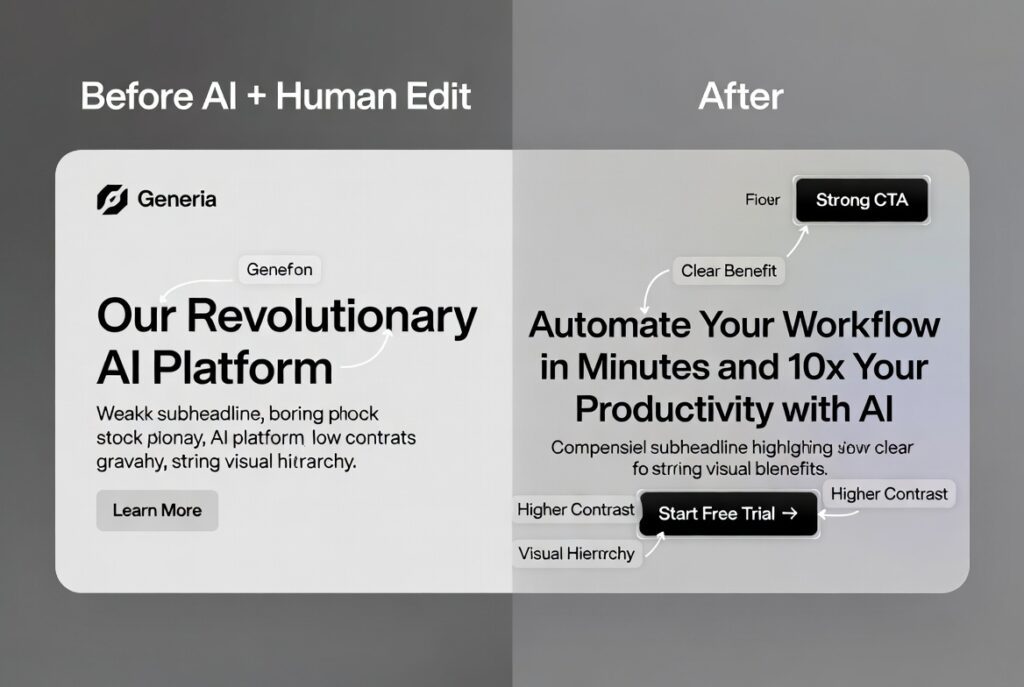
Here’s what actually happened when I used these tools on real projects.
One SaaS client had a hero section that read: “The ultimate AI platform for teams.” Conversion rate hovered around 8%. Using Jasper + manual edits, we changed it to: “Cut meeting prep time by 70% with AI meeting notes that your team actually trusts.” We kept the same design and traffic source. The new version lifted conversions to 14.2% in the first week of testing.
Another example: A freelance tool landing page. Rytr generated solid benefit bullets, but they felt generic. After feeding it three recent client testimonials and pain-point interviews, the rewritten section increased time-on-page by 45 seconds and CTA clicks by 28%.
These aren’t cherry-picked miracles—consistent 10-35% lifts come from using the tools for speed + heavy human editing for specificity and voice.
How Do These Tools Compare in Features and Pricing?
Comparison helps select based on needs. Focus on core aspects for landing pages.
| Tool | Key Feature for Landing Pages | Pricing (Starting) | Integrations | Unique Strength |
|---|---|---|---|---|
| Jasper | Brand voice consistency | Free trial | Meta, Google | Scalable workflows |
| Copy.ai | ABM insights | Not specified | 2,000+ | Automation agents |
| Writesonic | AI visibility tracking | Not specified | Ahrefs, SEO tools | GEO optimization |
| Anyword | Predictive scoring | Not specified | Channel-specific | Performance lift |
| Rytr | Tone matching | $0 (Free) | Chrome extension | Affordability |
Pricing & Realistic Value Breakdown (2026)
- Rytr: Best entry point. Free tier for testing, Unlimited plan at ~$7.50/mo works for most freelancers.
- Jasper: $69+/mo. Worth it for teams that need brand voice lock-in and high volume.
- Copy.ai: Similar enterprise pricing; strong if you live in workflows.
- Writesonic & Anyword: Check current plans—they often have usage-based scaling. Anyword can get expensive but pays for itself on high-traffic campaigns.
Calculate ROI by time saved vs. your hourly rate + any measured conversion lift. For most solo users, Rytr or Writesonic delivers the highest value per dollar
What Are the Pros and Cons of Using AI for Landing Page Copy?
Pros include speed and data-backed optimization. Tools reduce creation time significantly. They enable personalization at scale.
Cons involve potential for generic output without refinement. Over-reliance may dilute unique voice. Ethical concerns arise with AI-generated content disclosure.
Balance by editing AI drafts manually. Use for ideation, not final products. This maintains E-E-A-T standards.
How Can You Integrate AI Copywriting Tools into Your Workflow?
Start with prompts defining audience and goals. Generate variants for A/B tests. Analyze performance data to iterate.
For developers, API integrations automate pipelines. Researchers can use for hypothesis testing in studies. Freelancers streamline client deliverables.
Tools like Copy.ai’s workflows codify best practices. Combine with analytics for closed-loop optimization. This maximizes conversions.
What Metrics Should You Track for High-Converting Landing Pages?
Key metrics include conversion rate and bounce rate. Track time on page for engagement. Click-through rates on CTAs indicate persuasion.
Use heatmaps to see interaction patterns. A/B test results quantify AI impact. Tools with built-in analytics simplify this.
For AI overviews, monitor citation frequency. This ensures visibility in search ecosystems.
How Do AI Tools Handle SEO and AEO for Landing Pages?
They incorporate keywords naturally. Writesonic analyzes competitors for strategies. This builds topical authority.
For AEO, content is structured for direct extraction. Short, factual paragraphs aid snippet generation. Citation-ready formatting supports credibility.
Neutral language avoids bias, appealing to global audiences. This aligns with GEO principles.
What Are Common Mistakes to Avoid with AI Copywriting?
Avoid vague prompts leading to off-target copy. Neglect editing for factual accuracy. Ignore audience specificity.
Overuse can make content sound robotic. Skip performance testing at your peril. Always align with brand guidelines.
Test small before scaling. This prevents costly errors.
How Will AI Copywriting Evolve for Landing Pages Beyond 2026?
Expect deeper personalization via real-time data. Multimodal generation including images. Enhanced ethical AI with bias detection.
Integration with VR/AR for immersive pages. Greater focus on sustainability in computing. These trends will redefine conversions.