A no response email reminder is a follow-up message sent when someone hasn’t replied to an earlier email. To be effective: wait 3–5 business days, keep the message short, restate your ask clearly, and make replying feel easy — not obligatory.
You sent the email. You waited. Nothing.
Not a “no.” Not a “give me a week.” Just silence — the digital equivalent of someone walking past you mid-sentence.
Sending a no response email reminder feels awkward for most people. Too pushy and you look desperate. Too soft and it gets ignored again. There’s this invisible line between a follow-up that works and one that makes the other person feel guilty enough to close the tab.
Here’s the thing: the problem almost never lives in whether you follow up. It lives in how you do it. Most follow-ups read like a passive-aggressive nudge dressed up in professional language. The recipient can feel it — and they don’t reply.
What actually works is counterintuitive. The follow-up that gets a reply often looks like it doesn’t need one. It’s calm, specific, and gives the other person an easy exit if the timing isn’t right.
By the end of this, you’ll have a clear system for writing follow-up emails that don’t feel needy, don’t burn bridges, and — most importantly — actually get responses.
Table of Contents
Why Most Follow-Up Emails Don’t Work
Let’s start with the uncomfortable truth. Most follow-up emails fail not because the timing was off or the person is too busy. They fail because they create friction.
When someone reads “Just following up on my last email,” they already know what’s coming. It feels like a parent repeating themselves. The instinctive response is avoidance — not reply.
The psychological dynamic here is real. Research on email response behavior published by Harvard Business Review found that shorter emails get disproportionately higher reply rates. Specificity matters more than persistence. And the framing of a request — whether it feels like a demand or an invitation — changes reply rates dramatically.
Most follow-ups fail because they’re written from the sender’s anxiety, not the recipient’s experience.
That’s the shift worth making.
The Right Timing for a No Response Email Reminder
Timing is the most underrated variable in follow-up strategy.
Send too fast and you look anxious. Send too late and the original email has been buried under four days of new messages. Neither works in your favor.
Here’s a practical framework that holds across most professional contexts:
- First follow-up: 3–5 business days after the original email
- Second follow-up (if needed): 5–7 business days after the first
- Final follow-up: 7–10 business days after the second — this one closes the loop
💡 Pro Tip: If you’re following up on a time-sensitive request (a proposal, a contract, a job application), compress the window. Three business days is reasonable. For relationship-based conversations, give more breathing room.
The goal isn’t to remind them you exist. It’s to reappear at a moment when replying is the easiest path forward.
What a Good Follow-Up Email Actually Looks Like
Before the templates, understand the anatomy. Every effective no-reply follow-up email shares a few characteristics:
1. A subject line that doesn’t sound like a guilt trip “Just checking in” works fine. So does “Quick question about [topic]” or a direct reference to the original thread. What doesn’t work: “STILL waiting on your response” or anything that implies impatience.
2. One sentence that acknowledges the silence without weaponizing it Something like “I know things get busy” or “No worries if the timing isn’t right” costs you nothing and defuses the tension immediately.
3. A restated ask — clearer than the first time The original email might have been unclear. Use the follow-up as an opportunity to sharpen your request, not just repeat it.
4. An easy out This sounds counterintuitive, but giving someone permission to say no — or to redirect you — increases your reply rate. People avoid silence when they feel trapped. Give them a graceful exit and they’ll often take the other door instead.
Key Insight: The follow-up that says “No problem if this isn’t a fit right now — happy to reconnect when timing is better” almost always gets a reply. Because now they have to choose — and choosing is easier than ignoring.
7 No Response Email Reminder Templates
These are written for real situations. Adapt the language, keep the structure.
Template 1: The Simple Check-In (General Use)
Subject: Quick follow-up — [original topic]
Hi [Name],
Following up on my email from [timeframe — e.g., last week]. I wanted to make sure it didn’t slip through the cracks.
[One-sentence restatement of your original ask or update.]
Happy to answer any questions if that helps. Just reply here when you get a chance.
[Your name]
Template 2: The Easy Exit (Relationship-Preserving)
Subject: Re: [Original subject]
Hi [Name],
Reaching back out in case my last message got buried. Totally understand if the timing isn’t right — things pile up.
If [original ask] is still something worth exploring, I’d love to hear your thoughts. If not, no worries at all — just let me know and I’ll take it off your plate.
Either way, appreciate your time.
[Your name]
Template 3: The Clarifier (When You Think Your First Email Was Unclear)
Subject: Wanted to add some context — [topic]
Hi [Name],
Looking back at my last email, I realized I may not have explained [specific point] as clearly as I should have.
To put it simply: [one clear sentence restating what you need and why].
Does that change anything for you? Happy to jump on a quick call if easier.
[Your name]
Template 4: The Deadline-Sensitive Follow-Up
Subject: Time-sensitive — wanted to flag this
Hi [Name],
I want to make sure this doesn’t fall through given [deadline or event — e.g., the project kicks off next week / the offer expires Friday].
[One sentence restating the ask and the timeline.]
If now isn’t the right moment, just say the word and we can figure out next steps from there.
[Your name]
Template 5: The Final Follow-Up (The Polite Close)
Subject: Last note from me on this
Hi [Name],
This will be my last follow-up — I don’t want to fill your inbox if the timing isn’t right.
If you’re still interested in [topic], I’m happy to pick this up whenever works for you. If not, no hard feelings at all.
Wishing you well either way.
[Your name]
Template 6: The Internal Team Reminder
Subject: Checking in — [task/project name]
Hi [Name],
Just circling back on [specific deliverable or question] from [timeframe].
Wanted to make sure nothing’s blocking you before [deadline or next milestone]. Let me know if you need anything from my end to move this forward.
[Your name]
Template 7: The Sales Follow-Up (Non-Pushy Version)
Subject: Still worth a conversation?
Hi [Name],
I know you’re busy, so I’ll keep this short.
[One sentence about what you’re offering and the specific value it creates for them.]
If this is still relevant, I’d love five minutes to talk through it. If your priorities have shifted, no problem — just say so and I’ll stop following up.
Your call.
[Your name]
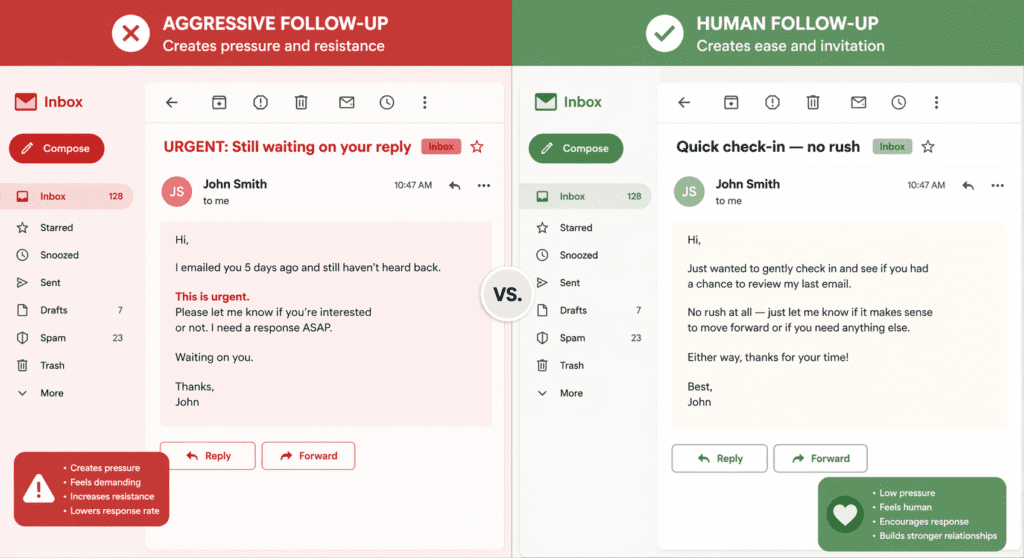
[Insert Image: no-response-email-reminder-tone-comparison.webp] Alt text: Comparison of aggressive vs. friendly no response email reminder tone in an inbox view
The Psychology Behind Why These Templates Work
None of these templates are magic. What they share is a common psychological principle: they remove obligation.
When a follow-up feels like a demand — even a politely worded one — the recipient enters avoidance mode. There’s no clear upside to replying. Either they have to deliver news they’ve been putting off, or they have to admit they forgot, or they have to say no. None of those feel great. So they do nothing.
The templates above are designed to shrink that perceived cost. “No problem if this isn’t a fit” tells the other person they won’t lose anything by replying honestly. The final follow-up template explicitly gives permission to disappear — and paradoxically, that’s often when people show back up.
This isn’t manipulation. It’s empathy applied to email.
Note: These templates work best in professional contexts. For personal communication or ongoing relationships, you can be even warmer and more direct. The goal is always to make the other person feel like replying is the natural next step — not a burden.
Comparison: Follow-Up Approaches Side by Side
| 📌 Approach | 🎯 Tone | 👥 Best For | ⚠️ Risk |
|---|---|---|---|
| Simple check-in | Neutral | General professional follow-up | Can feel generic if overused |
| Easy exit | Warm, low-pressure | Relationship-based outreach | May signal low confidence |
| Clarifier | Helpful | When your first email was complex | Admits you may have confused them |
| Deadline-sensitive | Urgent but calm | Time-bound requests or proposals | Can feel pushy if timed wrong |
| Final follow-up | Graceful closure | Last attempt before moving on | You close the door on further pursuit |
| Sales non-pushy | Direct, respectful | B2B outreach, proposals | Too soft for hot leads who just need a nudge |
Key Insight: No single template fits every situation. Matching the tone of your follow-up to the relationship stage and the original context is what separates a thoughtful follow-up from a generic one.
Common Mistakes That Kill Your Follow-Up Chances
Most people know they should follow up. Fewer know what they’re doing wrong when they do. Here are the patterns that reliably tank reply rates:
Sending too many follow-ups in sequence. Three is usually the maximum before you cross from persistent into annoying. After three unanswered messages, most professionals take that as a clear signal and move on.
Starting every email with “Just following up.” It’s become so common it now reads as filler. Try opening with a one-line context refresher instead: “Reaching back out about the proposal I sent last week.”
Making the ask vague. “Let me know what you think” requires work. “Can you confirm by Friday if you’d like to proceed?” requires a yes or no. Make it easy to answer.
Skipping the subject line strategy. Many recipients decide whether to open an email based on three things: who it’s from, what time it arrived, and the subject line. A subject line that reads like a passive-aggressive nudge gets ignored or worse — archived.
In practice, this usually means: reread your subject line and ask whether you’d open that email if you were the recipient. If the answer is “probably not,” rewrite it.
What to Do When No Response Emails Don’t Work
Sometimes, no amount of well-crafted follow-ups will get a reply. That’s worth acknowledging plainly.
There are scenarios where silence is the answer:
- The person has moved on from the role
- The project was deprioritized internally
- They’ve already made a decision and don’t want to deliver the news
After two or three follow-ups with no response, consider reaching out through a different channel — a LinkedIn message, a brief phone call, or a message to a different contact at the same organization. Sometimes the inbox itself is the problem.
And sometimes the most professional thing you can do is send one final message, close the loop cleanly, and move your attention elsewhere. The final follow-up template above does exactly that.
What most guides don’t mention is this: a clean, graceful exit often reactivates a stalled conversation weeks later. People remember the person who didn’t pressure them. When their priorities shift, they come back.
A Note on Automated Email Reminders
If you’re managing a high volume of outreach — sales sequences, client follow-ups, or partnership inquiries — doing this manually doesn’t scale. That’s where email automation tools become useful.
Platforms like Mailchimp and dedicated sales sequencing tools allow you to build multi-step follow-up sequences that trigger automatically when a contact doesn’t open or reply within a set window. The templates above translate directly into automated sequences — just map each one to the appropriate delay and trigger.
The edge case worth knowing about: automated follow-ups can backfire if they don’t account for replies. Use tools that pause a sequence the moment someone responds. Sending a “last follow-up” to someone who replied two days ago is one of the fastest ways to damage a relationship.
How long should I wait before sending a follow-up email when there’s no response?
How many follow-up emails should I send before giving up?
What’s the best subject line for a no response email reminder?
Should I mention that I didn’t get a reply in my follow-up email?
Is it better to follow up by email or by phone when there’s no reply?
What if my follow-up email also gets ignored?
Can I use the same follow-up template for both cold outreach and warm leads?
The Follow-Up That Doesn’t Feel Like One
The best no response email reminder doesn’t read like a reminder at all. It reads like a natural continuation — calm, clear, and genuinely easy to reply to. That’s the standard worth aiming for.
Three things to carry with you: wait long enough to be respectful, restate your ask more clearly than the first time, and always give the other person a graceful way to respond honestly. That combination beats volume, beats persistence, and beats any amount of clever phrasing.
Silence isn’t always rejection. Sometimes it’s just a full inbox and a busy week. Your job is to make it as easy as possible for the right answer to come back to you.
If you want to sharpen your email strategy further — templates, subject lines, sequence structures — explore more practical guides at geniostack.com.