React leads global frontend framework adoption in 2026, but “best” depends on context: Vue wins for approachability, Svelte for performance, Angular for enterprise structure, and Solid/Qwik for teams chasing raw speed. The right choice matches your team, traffic profile, and risk tolerance — not GitHub stars.
Most “best frontend framework” roundups repeat the same three data points — npm downloads, GitHub stars, and a satisfaction chart — then stop. That’s a popularity contest, not a decision-making tool. A framework that’s dominant on npm can still be the wrong choice for a five-person team building a content-heavy site that lives or dies on Core Web Vitals.
This guide treats framework selection as what it actually is: an engineering risk decision with long-term consequences for hiring, maintenance, and performance. Below, you’ll find a current front-end frameworks list, a breakdown of how adoption differs by country, and a practical risk management framework you can apply the next time you’re staring at a blank
Table of Contents
Front-End Frameworks List: What’s Actually Worth Learning in 2026
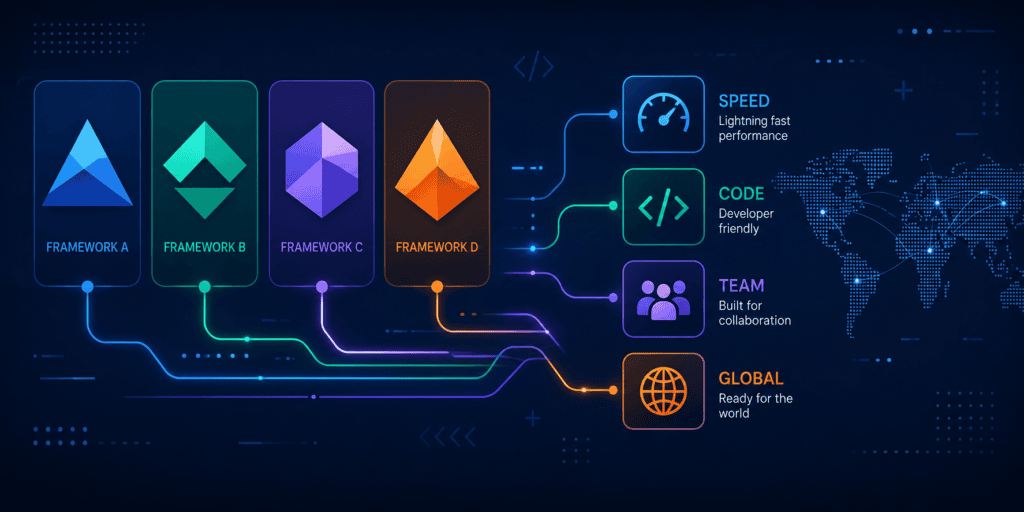
Not every framework on a “top 10” list deserves your attention. Here’s the front-end frameworks list that matters right now, based on real production usage rather than novelty.
- React — Still the default. Backed by Meta, dominant in job postings, and now shipping mature Server Components with a production-ready compiler that removes much of the manual memoization developers used to hand-write. Its meta-framework, Next.js, has become close to mandatory for new React projects.
- Vue — The framework most developers describe as the easiest to love. The Composition API gives it React-level flexibility while keeping Vue’s documentation genuinely beginner-friendly. Strong in Asia and among startups that want speed without a steep onboarding curve.
- Angular — A complete, opinionated framework rather than a library. Google-backed, TypeScript-first, and still the safest bet for large enterprise teams that want routing, forms, and state management built in rather than assembled from third-party packages. See Angular’s official docs for its current zoneless architecture.
- Svelte — Compiles away at build time instead of shipping a runtime, which is why its bundle sizes are dramatically smaller than React’s. It consistently posts the highest developer satisfaction scores of any major framework, even though its usage share is smaller.
- Solid — Fine-grained reactivity without a virtual DOM. Popular with developers who like React’s component model but want Svelte-level performance.
- Qwik — Built around “resumability,” meaning it ships almost no JavaScript on first load and only activates code when a user actually interacts with the page. Niche, but a genuine answer to slow-network, mobile-first use cases.
- Astro — Not a full app framework, but the go-to choice for content-heavy sites (blogs, marketing pages, documentation) that need near-zero JavaScript by default.
Key Takeaway: If you’re optimizing for hiring speed and ecosystem depth, React wins by a wide margin. If you’re optimizing for raw performance on a content site, Svelte or Astro will usually beat it.
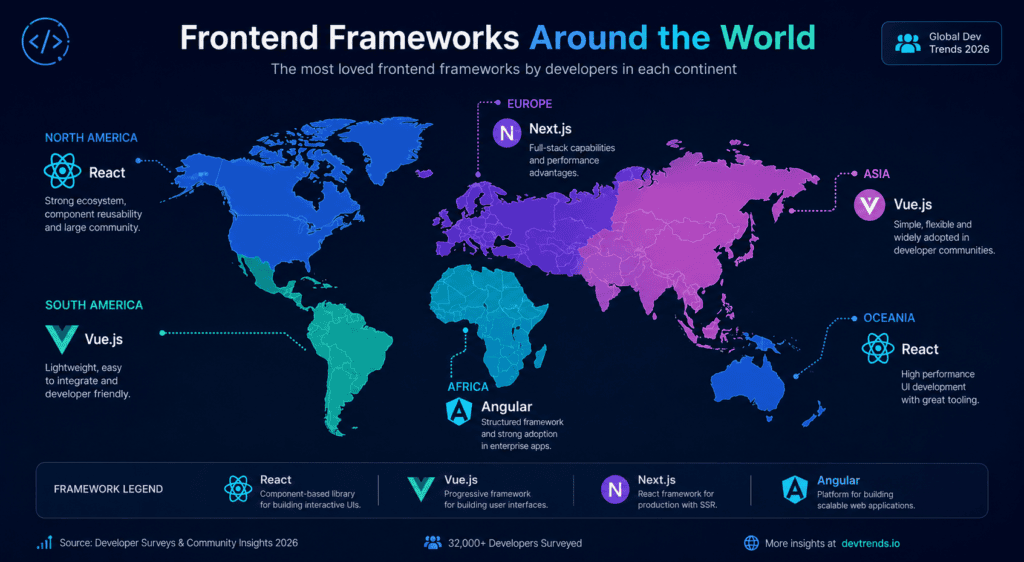
Frontend Frameworks’ Popularity by Country
Global download charts flatten a picture that looks very different once you zoom into specific regions — and this is where a lot of teams pick the wrong framework for their hiring market.
- North America and Western Europe: React is close to the default choice, with the deepest talent pool and the most job postings of any framework. Angular retains a stronghold in large enterprises — banking, government, and healthcare software — where its all-in-one structure and long-term Google backing reduce integration risk.
- Eastern Europe: Increasingly known as a hub for Angular development, particularly for outsourced and remote enterprise work, where teams value its rigid conventions for large distributed codebases.
- China and Southeast Asia: Vue has outsized traction. Chinese companies including Alibaba built major products on Vue, and many regional job listings specify it directly rather than treating it as interchangeable with React.
- India: A visible split by company type. Product startups and unicorns skew toward React, while IT services firms serving enterprise clients still lean heavily on Angular for its structured, framework-provided tooling.
- Asia-Pacific broadly: The fastest-growing region for both React and Vue roles, reflecting the region’s rapid expansion of consumer web and mobile-first products.
Key Takeaway: If you’re hiring locally rather than remotely, check regional job boards before committing — a framework that’s “dominant” globally may have a thin local talent pool in your specific market.
A Risk Management Framework for Choosing Your Frontend Stack
Here’s the part most comparison articles skip entirely: framework selection is a risk decision, and you can evaluate it the same way a project manager evaluates any technical risk — by scoring likelihood and impact across a defined set of categories, rather than by vibes or star counts.
Apply these five risk categories before you commit to a stack:
- Hiring risk. Can you actually staff this project in your target labor market and budget? A framework with excellent docs but a thin local talent pool creates a slow-moving hiring bottleneck that shows up six months into the project, not on day one.
- Migration and lock-in risk. How hard is it to leave later? React’s component model transfers reasonably well to other libraries; a deeply opinionated framework’s patterns transfer less cleanly, and rewrites of large codebases are expensive.
- Ecosystem risk. Does the framework have mature solutions for auth, forms, testing, and state management, or will your team be building and maintaining that tooling in-house? Thin ecosystems quietly become maintenance debt.
- Performance and SEO risk. For content or e-commerce sites, a heavy client-side bundle is a structural risk to search rankings and conversion, not a detail to optimize after launch. This is where Svelte, Astro, or Qwik often outperform heavier options.
- AI-tooling compatibility risk. With AI coding assistants now writing a meaningful share of frontend code in many teams, frameworks with the largest training-data footprint — React chief among them — currently get more reliable AI-assisted output. Smaller frameworks can see more hallucinated APIs and outdated suggestions from AI tools trained on less recent documentation.
Score each framework 1–3 on likelihood and impact per category, multiply, and sum. It won’t produce a single “correct” answer, but it will surface the risk you’re actually taking on — which is a far more honest exercise than ranking frameworks by GitHub stars.
Step-by-Step: Applying the Framework in a Real Project Decision
Step 1: Map Your Non-Negotiables
Before comparing frameworks, list what can’t be compromised: launch date, existing team skills, SEO dependency, and budget for third-party tooling. This matters because most bad framework choices come from skipping this step and jumping straight to a comparison chart.
Step 2: Score Each Candidate Against the Risk Framework
Run React, Vue, and one performance-focused option (Svelte or Astro) through the five-category scoring above. This forces disagreements within the team into the open early, rather than after six weeks of development.
Step 3: Prototype the Riskiest Category, Not the Easiest One
If SEO is your biggest risk category, build a throwaway prototype of your most content-heavy page in your top two candidates and measure actual load time—don’t trust benchmark blog posts. This is the single step most teams skip, and it’s the one that prevents expensive mistakes.
Frequently Asked Questions
Here are answers to some of the most common questions developers ask when choosing frontend frameworks.
Is React still worth learning in 2026?
Yes. React continues to offer the largest job market, the richest ecosystem, and the strongest AI tooling support among frontend frameworks, even though developer satisfaction has slightly declined compared to previous years.
Which frontend framework is best for beginners?
Vue is generally the easiest framework to learn because of its clean syntax, excellent documentation, and gradual learning curve. React is also beginner-friendly thanks to its massive community and abundance of learning resources.
Is Angular dying?
No. Angular adoption has stabilized rather than declined. It remains a preferred choice for enterprise applications, banking systems, and government projects where long-term maintainability is a top priority.
Should I choose a framework based on GitHub stars?
No. GitHub stars reflect popularity, not production readiness. Consider factors such as hiring availability, ecosystem maturity, long-term support, and maintenance costs before making a decision.
Do frontend frameworks matter for SEO?
Yes. Framework choice can significantly affect Core Web Vitals, page speed, and crawlability. Server-side rendering or static rendering solutions generally provide better SEO performance than purely client-side rendering.
Is Svelte production-ready for large projects?
Yes. Svelte is production-ready, but its ecosystem is still smaller than React or Angular. Large enterprise projects may require additional custom tooling and integrations.
How often should a team reevaluate its frontend framework choice?
Teams should reassess their framework during major product milestones, significant version releases, or when hiring and maintenance become challenging. Switching frameworks too frequently can create unnecessary technical debt.
Choosing the right frontend framework is ultimately a business decision disguised as a technical one, and the teams that get it right are the ones who evaluate risk before they fall in love with a syntax. For more deep dives into AI and web development strategy, explore the latest guides on Geniostack.