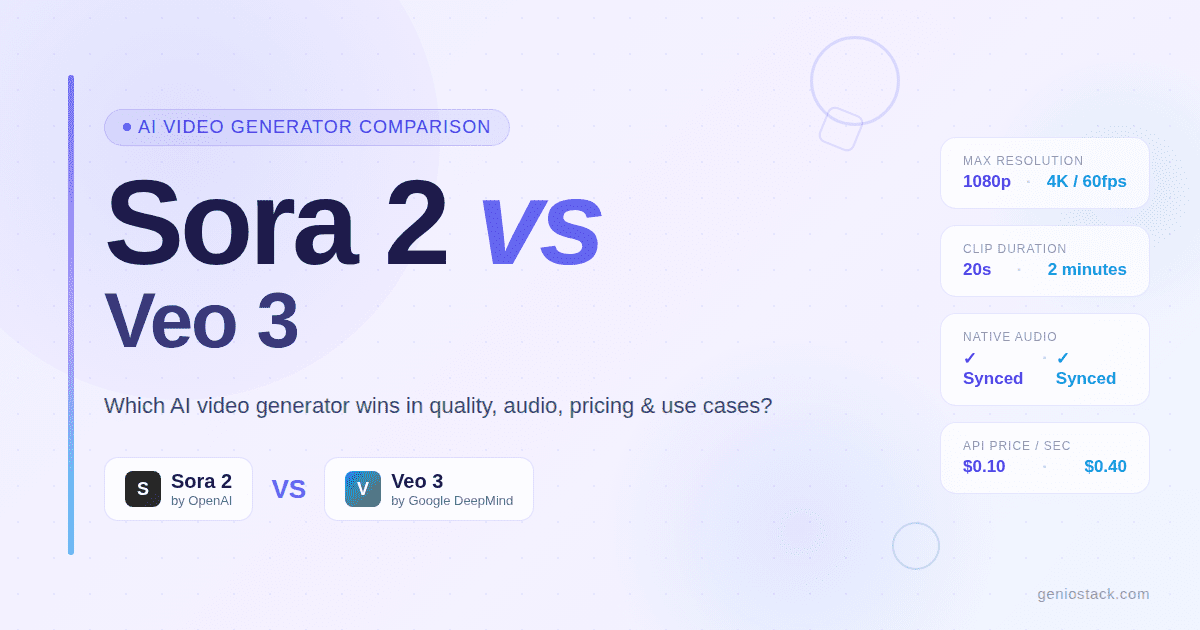
Sora 2 and Veo 3 are the two leading AI video generation models available today. Sora 2, launched by OpenAI in September 2025, produces up to 20-second clips at 1080p with native synchronized audio. Veo 3, developed by Google DeepMind and launched in May 2025, generates up to 4K, 60fps video with up to 2 minutes of duration and integrated audio. The best choice depends on your output quality needs, budget, and workflow.
The race for AI video supremacy is no longer a distant future — it is happening right now, and two models are leading the charge. OpenAI’s Sora 2 and Google DeepMind’s Veo 3 arrived within months of each other, and both promise to transform how creators, marketers, developers, and entrepreneurs produce video content.
But here is the uncomfortable truth: they are not interchangeable. One is built for social-first creativity and narrative storytelling. The other is engineered for cinematic, enterprise-grade output. Choosing the wrong one means wasting time, money, and creative energy.
This comparison breaks down every major dimension — video quality, audio fidelity, physics accuracy, pricing, API access, use cases, and the newer variants like Sora 2 Pro, Veo 3.1, and Veo 3 Fast — so you leave with a clear, confident decision.
The short answer: Sora 2 is better for accessible, social-driven content creation; Veo 3 is the professional choice for cinematic, long-form, high-resolution output.
Table of Contents
What Is Sora 2? (And How It Differs from the Original Sora)
Sora 2 is OpenAI’s second-generation text-to-video model, released on September 30, 2025. It is widely described as OpenAI’s “GPT-3.5 moment for video” — a generational leap that moved AI video generation from impressive demo territory into genuinely usable production tool.
Sora vs Sora 2: Key Improvements
Understanding the gap between the original Sora and Sora 2 matters because many users are still evaluating whether to upgrade their workflow.
The original Sora (launched in early 2024) was groundbreaking but flawed. It produced visually compelling clips but suffered from physics inconsistencies — objects floating inexplicably, characters defying gravity, and motion that felt algorithmically generated rather than physically real. Critically, it had no native audio, requiring creators to add sound separately in post-production.
Sora 2 addresses these limitations head-on:
- Native synchronized audio: Dialogue, ambient sound, and effects are generated in sync with the visuals — no more silent clips or mismatched audio tracks.
- Advanced physics simulation: Objects now collide, bounce, and interact with Newtonian plausibility, dramatically reducing post-production corrections.
- Longer, more coherent clips: Sora 2 supports up to 20 seconds (Pro users can push further), compared to the original model’s 6–10 second practical limit.
- Multi-modal input: Sora 2 accepts both text and image inputs; the original Sora was text-only.
- Multi-shot consistency: Camera angles can switch while characters, lighting, and visual details remain uniform across scenes.
- Cameo feature: Verified users can insert their own likeness and voice into AI-generated footage with consent controls built in.
Key Insight: Sora 1 proved AI video generation was possible. Sora 2 proves it is actually usable for professional creative work — a distinction that matters enormously for real-world workflows.
In practice, Sora 2 dramatically reduces the need for reshoots or heavy post-production editing. For social media creators, short-form marketers, and narrative storytellers, the upgrade is significant.
What Is Veo 3? Google DeepMind’s Cinematic Powerhouse
Veo 3 is Google DeepMind’s third-generation video model, launched in May 2025. It is integrated across Google’s product ecosystem — available via Gemini, Vertex AI, Google Flow, and YouTube’s content creation tools.
Where Sora 2 leans into social creativity and accessibility, Veo 3 is engineered for scale, precision, and cinematic quality. It is the first model in the Veo family to generate native audio — ambient noise, sound effects, and synchronized dialogue — as an integrated output rather than a post-production addition.
Core Veo 3 specifications:
- Resolution: Up to 4K / 60fps output, the highest resolution among mainstream AI video models.
- Video duration: Up to 2 minutes per clip — significantly longer than Sora 2’s 20-second maximum.
- Audio: Native generation with strong lip-sync and integrated sound design.
- Access: Available via Google Gemini API, Vertex AI, and Google Flow; bundled into Google AI Ultra ($249.99/month) for full access.
- API pricing: $0.40/second for standard generation with audio; $0.15/second for Veo 3 Fast (lower latency, slightly reduced precision).
Veo 3’s deep integration with Google’s ecosystem is a genuine advantage for enterprise users and developers. Teams already using Google Cloud Vertex AI or building on the Gemini API can incorporate Veo 3 directly into their pipelines without switching platforms.
Key Insight: Veo 3’s biggest differentiator is not just resolution — it is the 2-minute clip length combined with 4K quality, making it the only mainstream model capable of producing professional short films in a single generation.
One honest caveat: early user reports note that Veo 3’s audio generation is inconsistent in practice, with some clips generating completely silent despite the feature being enabled. Upscaling from 720p to 1080p can also strip existing audio. These are documented limitations worth factoring into production workflows. You can explore the full Veo 3 technical documentation on Google DeepMind’s official site for the latest specifications.
Sora 2 vs Veo 3: Head-to-Head Comparison Table
| Feature | Sora 2 | Veo 3 |
|---|---|---|
| Resolution | Up to 1080p | Up to 4K / 60fps |
| Max Clip Duration | Up to 20s (Pro: longer) | Up to 2 minutes |
| Native Audio | Yes — dialogue, SFX, ambience | Yes — lip-sync, sound design |
| Physics Accuracy | Advanced Newtonian | High, cinematic |
| Multi-Shot Consistency | Strong (camera angles, lighting) | Moderate |
| API Access | Limited / coming soon | Yes — Vertex AI, Gemini API |
| Free Tier | Yes (invite + US/CA IP) | Limited (Google Flow credits) |
| Pricing (Standard) | ~$0.10/sec | ~$0.40/sec |
| Best For | Social creators, storytellers | Professional, enterprise, cinematic |
| Ecosystem | OpenAI / ChatGPT | Google Cloud / Gemini |
| Winner | Accessibility & creativity | Quality & scale |
Sora 2 Pro vs Veo 3: When You Need the Premium Tier
For users pushing the limits of both platforms, the comparison shifts when premium tiers enter the picture.
Sora 2 Pro
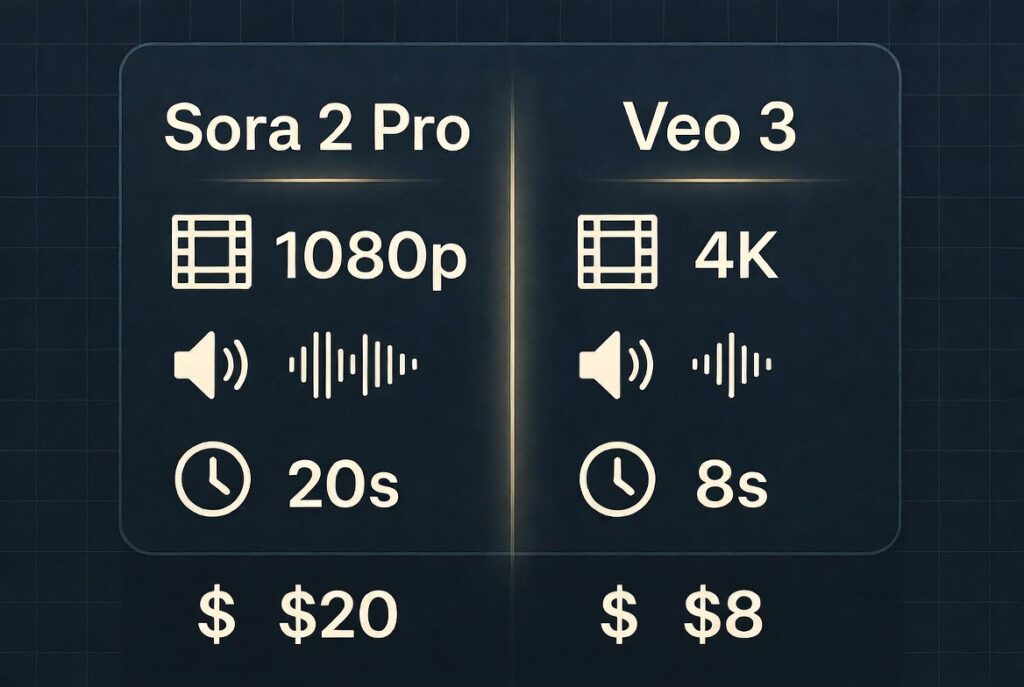
Sora 2 Pro is OpenAI’s highest-tier video generation offering, accessible via a ChatGPT Pro subscription ($200/month). It delivers uncompressed 1080p+ output, simulation-grade physics, and studio-quality audio — a significant step above the standard Sora 2 tier. Sora 2 Pro pricing via third-party API access runs approximately $0.30/second at 720p and $0.50/second for higher-resolution 1024×1792 output.
The standout addition in Sora 2 Pro is an expanded Cameo feature — verified creators can insert their verified likeness and voice with full motion matching, enabling a level of personalized storytelling that is genuinely novel in AI video.
For production studios, VFX teams, and commercial creators, Sora 2 Pro offers the most complete storytelling pipeline currently available from OpenAI.
Veo 3 at the Pro Level
At its premium tier, Veo 3 remains the resolution and duration king. For teams that require 4K / 60fps output or clips longer than 20 seconds, Veo 3 simply has no peer in the mainstream market. The Google AI Ultra plan ($249.99/month) bundles full Veo 3 access with the broader Google AI ecosystem, making it a compelling package for enterprise teams already embedded in Google Cloud.
Key Insight: Sora 2 Pro wins on creative control, audio quality, and narrative features. Veo 3 wins on raw output specifications — resolution, frame rate, and duration. Neither is universally “better” at the premium level; the right choice depends entirely on your production requirements.
Veo 3.1 vs Sora 2: What Changed with Google’s Latest Update
Google’s Veo 3.1 represents an iterative but meaningful upgrade over the original Veo 3. Available on Google Flow, Vertex AI, and the Gemini API, Veo 3.1 delivers:
- Richer, more precise audio with smoother lip-sync and realistic spatial sound positioning.
- Better narrative and story control — improved prompt adherence for complex multi-scene descriptions.
- More lifelike textures and stronger visual coherence across frames.
- Veo 3.1 Fast: A speed-optimised variant offering up to 40% faster rendering at slightly reduced resolution and lighting precision — ideal for social creators who prioritise turnaround time over maximum quality.
When comparing Veo 3.1 vs Sora 2 directly, Veo 3.1 gains a notable edge in visual texture fidelity and audio naturalness. However, Sora 2 still leads on multi-shot consistency and the creative Cameo feature. Pricing for Veo 3.1 Fast is $0.15/second; standard Veo 3.1 (with audio) remains at $0.40/second.
The honest assessment: Veo 3.1 is a stronger choice for creators who need high production value and professional polish. Sora 2 remains the better option for dynamic, character-driven storytelling that prioritises creative control over cinematic resolution.
For a broader perspective on where AI video is heading, the MIT Technology Review’s coverage of generative AI provides valuable industry context.
Sora 2 vs Nano Banana: Understanding the Wider AI Video Landscape
Beyond the Sora 2 and Veo 3 rivalry, creators sometimes encounter references to models like Nano Banana — a lightweight, experimental text-to-video model optimised for speed and accessibility on constrained hardware. Nano Banana is not in the same performance tier as Sora 2 or Veo 3. It is best understood as a fast-generation tool for low-stakes, rough-cut content rather than a production-grade competitor.
When evaluating Sora 2 vs Nano Banana, the comparison is less about quality trade-offs and more about use-case fit: Nano Banana suits rapid prototyping and concept visualisation; Sora 2 is built for finished, shareable content. For any creator serious about output quality, Sora 2 and Veo 3 remain the benchmarks.
Real-World Use Cases: Which Model Should You Choose?
Choose Sora 2 if you are:
- A social media creator producing short-form content for TikTok, Instagram Reels, or YouTube Shorts.
- A marketer who needs fast, visually engaging clips with synced voiceover and effects.
- A storyteller requiring multi-shot narrative consistency — characters and lighting staying coherent across angle changes.
- Working in multiple languages — Sora 2 handles multilingual dialogue generation well.
- On a limited budget — the free tier (US/Canada with invite code) makes it accessible to independent creators.
Choose Veo 3 if you are:
- A professional filmmaker or VFX artist who requires 4K / 60fps output for high-end deliverables.
- An enterprise team building video generation into a Google Cloud or Gemini API workflow.
- A developer who needs API access today — Veo 3’s API is live; Sora 2’s is still in limited rollout.
- Creating longer-format content that exceeds 20 seconds — Veo 3’s 2-minute generation is unmatched.
- Prioritising cinematic realism over narrative creativity in your output.
In practice, many production teams use both: Sora 2 for rapid content ideation and social output, and Veo 3 for polished, long-form deliverables. This dual-model workflow is increasingly common among agencies and content studios.
According to OpenAI’s official Sora documentation, Sora 2 is designed to balance accessibility with professional output — a design philosophy that directly shapes its feature set and pricing structure.
Pricing Comparison: What Does Each Model Actually Cost?
Understanding the total cost of ownership — not just headline per-second pricing — is critical for making a financially sensible decision.
Sora 2 Pricing:
- Free tier: Available (invite code required, US/Canada IP)
- ChatGPT Plus ($20/month): Provides zero Sora 2 benefits — standard free-tier limits apply.
- ChatGPT Pro ($200/month): Full Sora 2 Pro access with 10,000 credits.
- API pricing: ~$0.10/second (720p standard); ~$0.30–$0.50/second (Pro / high-res).
Veo 3 Pricing:
- Google AI Pro (lower tier): Limited Veo 3 Fast access.
- Google AI Ultra ($249.99/month): Full Veo 3 access, 25,000 credits.
- API: $0.40/second (video + audio); $0.15/second (Veo 3 Fast).
- Veo 3 on third-party platforms (e.g., ImagineArt): $19.99/month (1,000 credits).
The verdict on pricing: Sora 2 is meaningfully more cost-effective for individual creators and small teams. Veo 3’s pricing reflects its enterprise positioning — expensive per second at the highest quality tier, but bundled into Google’s ecosystem in ways that simplify billing for large organisations.
Key Insight: If you are a solo creator or startup, Sora 2’s pricing model is significantly more accessible. If you are an enterprise team already on Google Cloud, Veo 3’s bundle pricing can represent excellent value relative to standalone API costs.
Sora 2 vs Veo 3 — The Verdict
The Sora 2 vs Veo 3 debate does not have a universal winner — it has a winner for your use case.
- Sora 2 is the better choice for content creators, marketers, and storytellers who need accessible, social-ready video with strong character consistency and native audio. The free tier and creative-first feature set make it the most approachable option for independent creators.
- Veo 3 is the professional’s tool — built for cinematic 4K output, longer clips, and enterprise-scale API integration. If resolution, duration, and Google ecosystem compatibility are priorities, Veo 3 wins outright.
- Sora 2 Pro vs Veo 3 at the premium level comes down to narrative control versus output specifications — both are exceptional; the choice is dictated by production requirements.
The AI video space is evolving at extraordinary speed. Both models will continue improving, and today’s limitations may be tomorrow’s solved problems.
Ready to go deeper on the tools shaping the future of AI-powered content? Explore the latest guides, comparisons, and practical tutorials at Geniostack — your home for actionable AI insights.