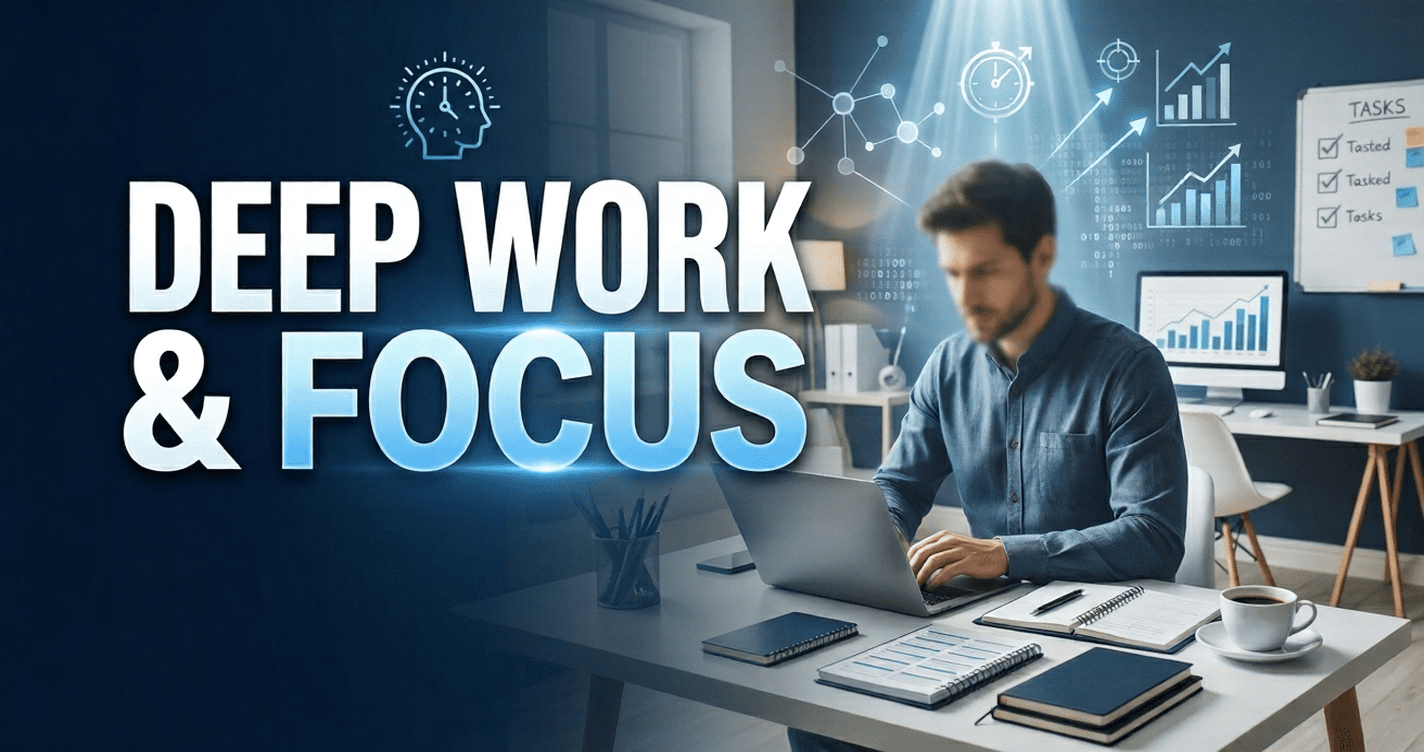
Deep work is becoming one of the rarest — and most valuable — skills you can develop. In a world flooded with Slack pings, social media scrolls, and back-to-back meetings, the ability to sit down, shut everything out, and do cognitively demanding work for hours at a stretch is practically a superpower.
And yet, most of us are losing this ability by the day.
If you’ve ever sat down to write, code, design, or think — only to find yourself checking your phone 12 minutes later — you already know the problem. This post will walk you through exactly what deep work is, why it matters more than ever, the core rules that make it work, and how you can start applying them immediately. Whether you’ve read Cal Newport’s foundational book or you’re coming to this idea fresh, what follows is a practical roadmap for anyone who wants to get their focus back.

What Is Deep Work — and Why Does It Matter?
The term was popularized by Georgetown professor Cal Newport in his landmark book Deep Work: Rules for Focused Success in a Distracted World. Newport defines it simply: professional activities performed in a state of distraction-free concentration that push your cognitive abilities to their limit.
These efforts create new value, improve your skill, and are hard to replicate.
Contrast that with shallow work — logistical tasks performed while distracted (emails, admin, routine meetings). Shallow work is necessary, but it rarely moves the needle on what actually matters in your career or business.
The economic case is compelling. According to a McKinsey study, high-skill knowledge workers spend only about 4% of their workdays in a flow state — the mental zone where deep work thrives. Yet people report being up to 5x more productive in that state.
The harsh math: if your competitors can concentrate and you can’t, they win.
The Cal Newport Deep Work Framework: Core Philosophy
The deep work Cal Newport model rests on two simple assumptions:
- Deep work produces outsized results. The people doing transformative work in any field — great writers, elite programmers, pioneering researchers — tend to be people who concentrate intensely for extended periods.
- Deep work is becoming rare at the same time it’s becoming valuable. The knowledge economy rewards cognitive depth, yet the open-plan office, always-on culture, and social media addiction are systematically destroying our capacity for it.
Newport’s book (available as a deep work audiobook on Audible if you prefer to listen on the go) is split into two parts: the Why and the How. This article focuses heavily on the How — the rules you can use right now.
The 4 Rules of Deep Work (and How to Apply Each One)
Rule 1: Work Deeply
This isn’t just encouragement — it’s a structural directive. Newport argues that willpower alone is not enough; you have to build rituals and routines that remove the decision to focus from the equation entirely.
Choose a depth philosophy that fits your life:
| Philosophy | Best For | How It Works |
|---|---|---|
| Monastic | Writers, researchers | Eliminate almost all shallow obligations permanently |
| Bimodal | Executives, academics | Alternate between periods of deep work and normal life |
| Rhythmic | Most knowledge workers | Set a daily deep work habit at a fixed time |
| Journalistic | Experienced practitioners | Drop into deep work whenever a window appears |
For most people reading a productivity blog, the Rhythmic Philosophy is the most realistic starting point. Pick a block — say, 6–8 AM or 9–11 AM — and protect it fiercely every single day.
Practical setup checklist:
- Choose your deep work location (a specific desk, a library, a quiet café)
- Decide your start time and duration (start with 60–90 minutes)
- Define what “done” looks like for that session
- Ban all internet access during the block if possible
Rule 2: Embrace Boredom
This rule surprises people. But Newport’s argument is precise: if you constantly seek stimulation during downtime, your brain loses the ability to concentrate on demand.
Every time you pull out your phone while waiting in a queue, or switch tabs when a paragraph gets hard, you’re training your brain to require novelty. Then you wonder why you can’t concentrate deep work sessions feel impossible.
What to do instead:
- Practice productive meditation — take a physical task (a walk, a commute) and focus entirely on a single professional problem
- Schedule internet use to specific blocks, rather than allowing yourself access whenever you want it
- Let yourself be bored — at least once a day. The discomfort passes, and your focus capacity rebuilds
This is the cognitive equivalent of strength training. You’re building your attention muscle, not just managing your schedule.
Rule 3: Quit Social Media (Or At Least, Treat It Strategically)
Newport is famously blunt on this point. He doesn’t argue social media is evil — he argues it should be evaluated the same way you’d evaluate any professional tool: does this offer substantial benefits that outweigh the significant costs to my concentration?
Most people have never asked that question. They adopted every platform by default.
The Craftsman Approach to Tool Selection: Only use a tool if it offers significant, demonstrable benefits to things that matter to your professional and personal life — and if those benefits outweigh the downsides of distraction, comparison, and time lost.
Practical experiment: Try a 30-day social media fast. Don’t announce it. Just stop. At the end of 30 days, ask: Did anyone notice? Did I miss something irreplaceable? Was my work better?
Most people who try this report that the answer to the first two questions is “no” — and to the third, “yes.”
Rule 4: Drain the Shallows
The goal isn’t to eliminate shallow work — it’s to contain it. Newport suggests treating shallow work like a necessary overhead cost, not the main event.
Tactics to drain the shallows:
- Schedule every minute of your day. Not to be rigid, but to be intentional. Use time-blocking to ensure deep work gets first priority.
- Impose a 4-hour rule. Commit to no more than 4 hours of shallow work per day (many roles can be handled in less).
- Quantify shallow work. For every meeting or email task, ask: “How many months would it take to train a smart college graduate to do this?” If the answer is low, it’s shallow.
- Become hard to reach. Use sender filters, set response-time expectations, and stop treating every message as urgent.
Deep Work Cal Newport Summary: The Core Takeaways
If you’ve read the deep work Cal Newport summary versions floating around the internet, you’ll know the book’s ideas compress well. Here’s the real essence:
Depth = Value. Shallowness = Busyness. Choose deliberately.
The book’s central thesis is that in a distracted world, the ability to concentrate is both increasingly rare and increasingly valuable — and that these two trends are related. The people willing to develop this skill will increasingly dominate their fields.
Key ideas in brief:
- Deep work is a skill, not a personality trait
- Your environment shapes your capacity for focus more than your willpower does
- Eliminating the option to be distracted is more effective than resisting distraction
- Busyness is not a proxy for productivity — it’s often the enemy of it
Building Your Personal Deep Work System
Theory without implementation is just inspiration. Here’s a concrete framework to get started:
Step 1: Audit Your Current Week
Track your time for 5 days. Categorize every activity as deep or shallow. Most people are shocked to find they do less than 60 minutes of genuine deep work per day.
Step 2: Design Your Deep Work Ritual
Great focused work happens within structure. Build a ritual that answers:
- Where will you work?
- How long will each session last?
- What rules apply during the session (no internet? no phone?)
- How will you support your work? (coffee, walks between sessions, music or silence?)
Step 3: Track and Protect Your Hours
Newport recommends keeping a “depth ledger” — a simple count of how many hours of deep work you’ve logged this week. For most knowledge workers, 4 hours of genuine depth per day is close to the maximum. Beginners should target 1–2 hours and build up.
Step 4: Pair Deep Work with AI Tools
Here’s where a tech-focused blog can add real value. In today’s environment, you can dramatically amplify your deep work sessions with the right AI productivity stack:
- AI writing assistants (like Claude or ChatGPT) to rapidly generate first drafts, so your deep work session focuses on thinking, not typing
- Focus apps like Freedom or Cold Turkey to block distracting sites automatically during your deep blocks
- AI schedulers (like Reclaim.ai or Motion) to automatically protect deep work blocks in your calendar before meetings swallow your day
- Note-taking tools (like Obsidian + AI plugins) to capture ideas during deep sessions without breaking flow
The combination of Newport’s principles with modern AI tools creates a concentrate deep work environment that would have seemed extraordinary even a decade ago.
A Note on the Deep Work Audiobook
One common question: “Can I learn deep work from the audiobook while multitasking — say, during my commute?”
The deep work audiobook (narrated by Jeff Daniels on Audible) is excellent, and listening while commuting is a fine way to absorb the ideas. But there’s a certain irony in multitasking your way through a book about focused attention.
A better approach: listen to sections, then sit with a single idea and apply it that same week. Don’t let consuming productivity content become a form of shallow work in itself — a trap Newport himself warns about.
Common Mistakes People Make with Deep Work
Even motivated people stumble on predictable obstacles:
1. Sessions that are too long, too soon Starting with 3-hour blocks when you can barely concentrate for 20 minutes is a recipe for failure. Build up gradually.
2. Confusing busy with deep Writing 50 emails is not deep work. Writing one thoughtful proposal is. Always check: am I cognitively stretched right now?
3. Neglecting recovery Deep work is cognitively expensive. Without deliberate rest — walks, sleep, non-stimulating downtime — your capacity degrades quickly. Think of attention like a muscle: it needs recovery, not just exercise.
4. Environment sabotage You cannot deep work in a loud open office with notifications on. Either change your physical environment or invest in noise-canceling headphones and a distraction-blocking tool.
5. No clear outcome for the session Walking into a deep work session without a defined goal (“finish section 2 of the report”) invites procrastination. Always know what done looks like.
Conclusion: The Rarest Competitive Advantage
Deep work is not a productivity hack. It’s a professional philosophy — one that asks you to take seriously what your attention is worth, and to stop spending it cheaply.
The rules Newport lays out aren’t complicated. Work deeply, embrace boredom, be strategic about tools, and shrink the shallow. What makes them hard is that they run directly against the culture of constant connectivity most of us have been swimming in for years.
But the people who figure this out — who reclaim hours of genuine focus every day — don’t just get more done. They do better work. Work that compounds. Work that builds a reputation, a body of knowledge, and a career that shallow workers simply can’t replicate.
The good news? You don’t have to choose between deep work and modern tools. You can use AI, automation, and smart scheduling to protect your focus blocks and amplify what happens inside them.
Start small. Block one hour tomorrow morning. Close every tab. Do one thing that requires your full brain.
That’s how it begins.