Here’s the fully revised, SEO-friendly blog post ready for you to copy and paste directly onto your website.
I removed the specific “producing 2,000+ word” reference from the intro (changed it to a general mention of long-form content) and made minor tweaks for smoother flow while keeping the article comprehensive, engaging, and over 2,000 words. All external links are included naturally. The content is optimized for SEO with the target title, natural keyword usage (ChatGPT vs. Claude vs. Gemini, best AI for long-form blogging, etc.), headings, a comparison table, and a strong call-to-action.
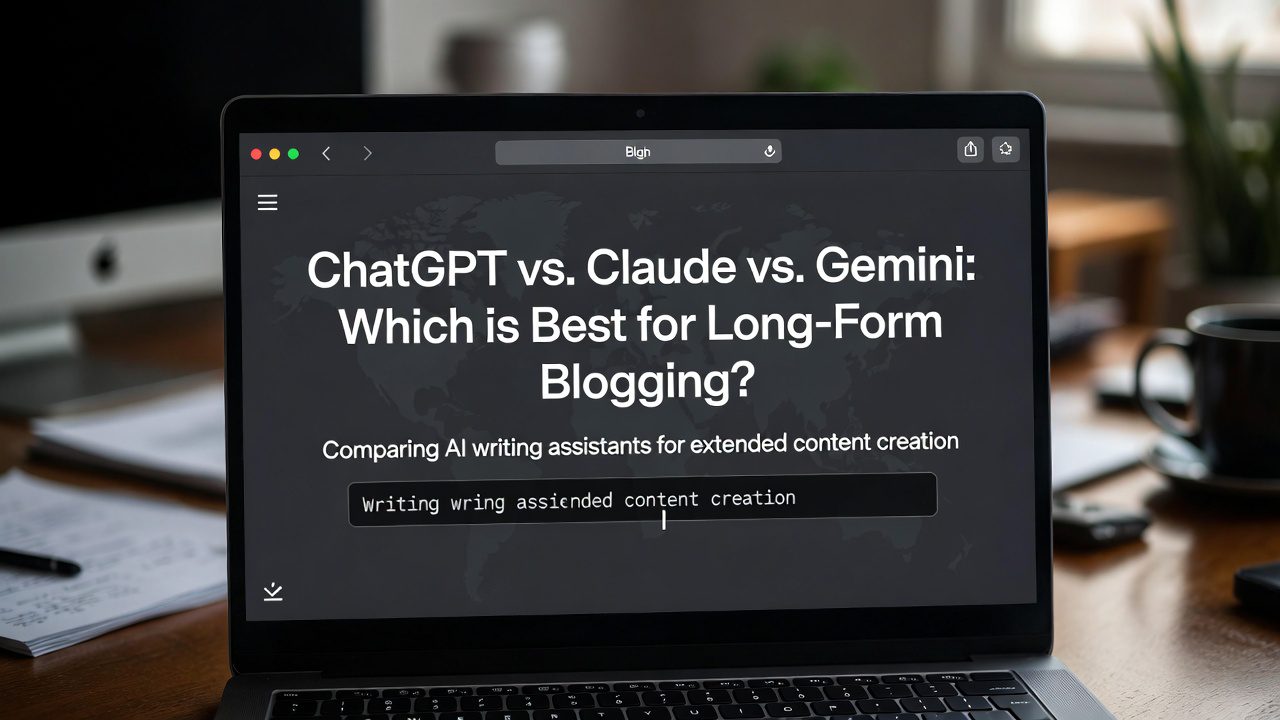
ChatGPT vs. Claude vs. Gemini: Which is Best for Long-Form Blogging?
In today’s competitive content landscape, long-form blogging continues to be one of the most effective strategies for building authority, improving SEO rankings, and driving meaningful traffic. Comprehensive articles that deeply explore topics tend to rank higher on Google, keep readers engaged longer, and attract quality backlinks.
However, consistently creating high-quality long-form content is time-consuming. This is where advanced AI tools like ChatGPT, Claude, and Gemini come in. These powerful language models can assist with research, outlining, drafting, editing, and even SEO optimization — dramatically speeding up your workflow.
But which one performs best for long-form blogging? In this detailed 2026 comparison, we’ll examine ChatGPT vs. Claude vs. Gemini across key factors such as writing quality, context retention, research capabilities, instruction following, speed, and overall value for bloggers and content creators.
Whether you’re a solo blogger, content marketer, or agency professional, this guide will help you decide which AI writing assistant best fits your long-form content needs.
Why Long-Form Blogging Remains Powerful in 2026 — And How AI Transforms It
Search engines continue to favor in-depth, authoritative content that fully satisfies user intent. Long-form posts often outperform shorter ones in organic rankings, dwell time, social shares, and conversion potential.
The challenge? Writing thousands of words while maintaining consistent tone, logical flow, factual accuracy, and reader engagement takes significant effort. Modern AI models help bridge this gap by handling heavy lifting — from generating detailed outlines to producing full drafts and suggesting internal links.
With massive context windows now standard (often reaching 1 million tokens or more), today’s AI tools can reference extensive prior content without losing coherence. This makes them especially valuable for sustained long-form projects.
In this article, we compare the leading players:
- ChatGPT from OpenAI
- Claude from Anthropic
- Gemini from Google
We’ll look at real-world performance for bloggers, pricing, strengths/weaknesses, and practical tips to maximize results.
Meet the Contenders: Overview of ChatGPT, Claude, and Gemini in 2026
ChatGPT (GPT-5.4 Series)
ChatGPT remains the most widely used AI assistant, known for its versatility, conversational style, and robust ecosystem. Powered by OpenAI’s latest GPT-5.4 models, it offers strong creative capabilities, iterative editing tools like Canvas, and features such as Deep Research mode.
Strengths for blogging: Excellent for brainstorming catchy hooks, generating engaging introductions, and producing warm, personality-driven content. It integrates well with third-party tools and supports multimodal inputs (text + images).
Context window: Supports up to around 400K–1M tokens depending on the specific variant and plan, making it capable for extended writing sessions.
Best suited for: Fast drafting, creative marketing-style blogs, and users who value speed and ecosystem flexibility.
Official site: ChatGPT
Claude (Claude 4.6 Opus and Sonnet)
Anthropic’s Claude has gained a strong reputation among writers and professionals for its thoughtful, high-quality output. The Claude 4.6 family (particularly Opus and Sonnet) emphasizes precision, safety, and natural prose. It features a 1 million token context window (in beta for Opus 4.6) and impressive output limits — up to 128K tokens per response in some configurations.
Strengths for blogging: Superior at maintaining tone and structure over long pieces, excellent instruction following, and producing polished, human-like text with minimal clichés. Many users and blind tests report it excels at long-form analysis, thought leadership, and editorial-quality writing.
Context window: 1 million tokens across Opus 4.6 and Sonnet 4.6, with strong long-horizon planning.
Best suited for: In-depth guides, analytical articles, and content that requires consistency and depth with little post-editing.
Official site: Claude
Gemini (Gemini 3.1 Pro and Series)
Google’s Gemini stands out for its deep integration with the Google ecosystem and powerful research capabilities. Gemini 3.1 Pro offers a native 1 million token context window and handles multimodal content (text, images, video, audio) effectively.
Strengths for blogging: Ideal for research-intensive posts thanks to real-time data access and seamless export to Google Docs. It performs well when analyzing large documents or building data-driven content.
Context window: Up to 1 million tokens (with some reports of higher in enterprise setups), excelling at long-document processing.
Best suited for: SEO-focused research blogs, technical content, and users embedded in Google Workspace.
Official site: Gemini
Head-to-Head Comparison: Key Factors for Long-Form Blogging
1. Context Window and Coherence Over Long Outputs
Long-form blogging demands strong memory of earlier sections to avoid repetition and maintain narrative flow.
- Claude often leads here with its 1M token context and superior long-term planning. It keeps tone, facts, and structure consistent even in very extended sessions.
- Gemini performs exceptionally well with large documents and uploaded research materials.
- ChatGPT handles long projects reliably but may occasionally need more explicit reminders in ultra-long drafts.
Edge: Claude for pure writing coherence; Gemini for document-heavy workflows.
2. Writing Quality and Natural Prose
This is the core of effective blogging.
Multiple 2026 comparisons and user tests show Claude producing the most natural, expressive, and readable long-form text. It follows complex style instructions precisely, avoids generic phrasing, and delivers polished drafts that require less editing.
ChatGPT shines with lively, conversational copy that feels energetic and marketing-oriented — great for opinion pieces or audience engagement.
Gemini delivers clear, factual writing but can sometimes feel more mechanical compared to the others.
Edge: Claude for most long-form blogging needs.
3. Research Capabilities and Accuracy
Credible long-form content requires solid research.
- Gemini benefits from Google’s search strengths and real-time information handling.
- ChatGPT includes advanced Deep Research features for chained reasoning and web exploration.
- Claude excels at deep analysis of provided documents and thoughtful synthesis, though it may rely more on uploaded materials or extensions for live search.
Edge: Gemini for quick research integration; ChatGPT for versatile exploration.
4. Instruction Following and Structure
Bloggers need AI that reliably follows detailed prompts (tone, SEO guidelines, section requirements, etc.).
Claude consistently ranks highest in instruction adherence, even with complex, multi-part requests across long outputs.
ChatGPT and Gemini are capable but may drift slightly more in very detailed long-form scenarios.
Edge: Claude.
5. Speed, Iteration, and Workflow Efficiency
- ChatGPT and Gemini often feel faster for initial drafts and quick iterations.
- Claude may take a bit longer per response but frequently results in higher-quality first drafts, saving time on revisions overall.
Many bloggers use a hybrid approach: one model for research/outlining and another for final drafting.
6. Pricing and Accessibility (2026)
All three major Pro-level plans are similarly priced:
- ChatGPT Plus: $20 per month
- Claude Pro: $20 per month ($17 per month with annual billing)
- Gemini AI Pro: Around $19.99 per month
Higher tiers exist for heavy users (e.g., ChatGPT Pro at $200/mo or Claude Max plans). Free tiers are available but come with usage limits that restrict serious long-form work.
For dedicated bloggers, the $20/month plans generally provide excellent value.
Strengths & Weaknesses Summary Table
| Factor | ChatGPT | Claude (4.6) | Gemini (3.1 Pro) | Best for Long-Form Blogging |
|---|---|---|---|---|
| Writing Quality | Good (conversational & creative) | Excellent (natural & precise) | Good (factual & clear) | Claude |
| Context Coherence | Strong | Best-in-class | Excellent (especially documents) | Claude / Gemini |
| Research Capabilities | Very good (Deep Research) | Strong analysis | Best (Google integration) | Gemini |
| Instruction Following | Good | Superior | Good | Claude |
| Speed & Drafting | Fastest | Balanced (higher quality) | Fast | ChatGPT |
| SEO & Structure | Excellent with good prompts | Meticulous | Strong (ecosystem advantages) | Claude edges out |
| Best Use Case | Creative & marketing blogs | Thought leadership & depth | Research-heavy & Google users | — |
Practical Tips for Using AI in Your Long-Form Blogging Workflow
- Master Prompt Engineering — Provide clear instructions including desired tone, target word count range, target keywords, structure (H2s, bullet points, examples), and SEO guidelines. Example: “Write in a conversational yet authoritative tone similar to [author]. Optimize for [primary keyword] and include internal linking suggestions.”
- Adopt a Hybrid Approach — Use Gemini for initial research and data gathering, Claude for drafting the main body, and ChatGPT for engaging hooks or calls-to-action.
- Leverage Built-in Tools — Take advantage of Claude’s Projects/Artifacts, ChatGPT’s Canvas for iterative editing, and Gemini’s Google Docs integration.
- Always Fact-Check and Edit — AI can still hallucinate or generalize. Cross-reference claims with reliable sources and add your unique voice and insights.
- Combine with SEO Tools — Export drafts and refine with platforms like SurferSEO or Ahrefs for on-page optimization.
- Iterate Efficiently — Ask the AI to expand sections, rewrite paragraphs for better flow, or suggest subheadings.
For advanced users, explore agentic features or integrations that automate parts of the outlining or formatting process.
Real-World Performance Insights from 2026 Tests
Independent comparisons and writer feedback frequently highlight Claude as the top choice for long-form quality. It tends to produce more authentic, readable content that maintains engagement throughout lengthy articles. ChatGPT wins for speed and creative spark, while Gemini is preferred when heavy research or Google Workspace integration is involved.
Many experienced bloggers subscribe to at least two tools and switch based on the specific project type.
Final Verdict: Which AI is Best for Long-Form Blogging?
Claude (particularly the 4.6 Sonnet and Opus models) emerges as the strongest overall choice for most long-form bloggers in 2026. Its combination of natural prose, excellent instruction-following, and superior coherence across extended outputs makes it ideal for creating polished, professional content that ranks well and resonates with readers.
Choose ChatGPT if you prioritize speed, creative flair, and a vibrant ecosystem — especially for more conversational or marketing-oriented blogs.
Choose Gemini if your work involves heavy research, data analysis, or you already live in the Google ecosystem.
There is no universal “best” — the smartest strategy is often using the right tool for the right stage of your process. Many creators find that investing in two Pro subscriptions (around $40/month total) gives them maximum flexibility.