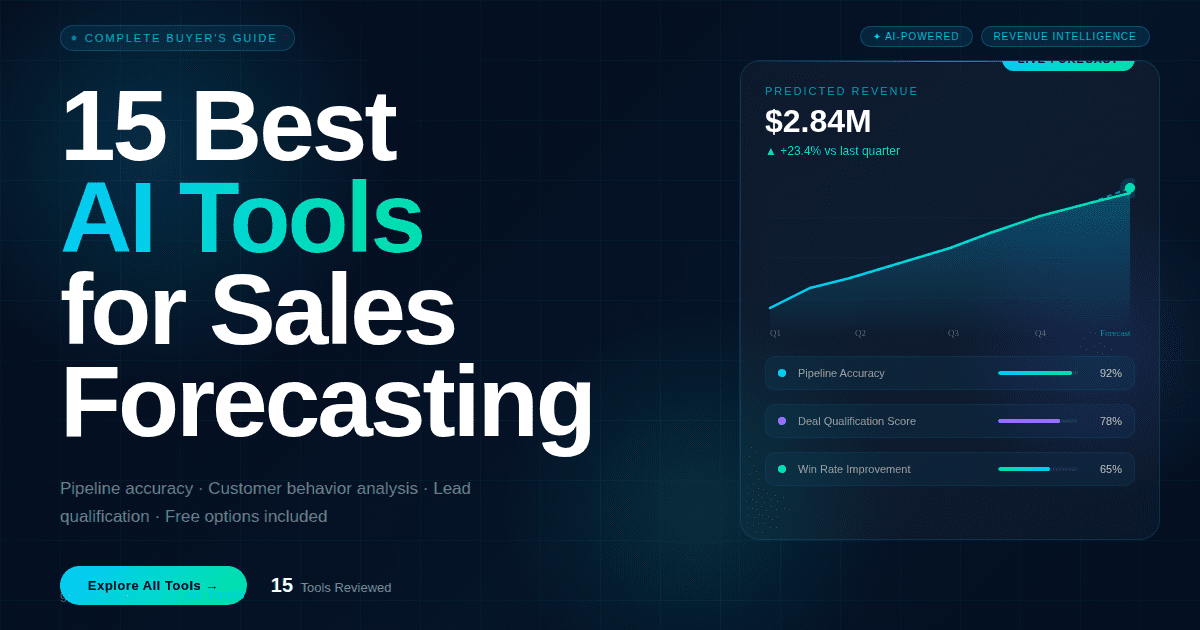
AI tools for sales forecasting use machine learning and predictive analytics to analyze historical sales data, buyer signals, and pipeline activity — then generate accurate revenue predictions. The best tools go beyond simple projections by incorporating deal health scores, customer behaviour patterns, and rep performance data to help revenue teams forecast with confidence rather than guesswork.
Every sales leader has been there: the quarter ends, and the number you confidently reported to the board looks nothing like what actually closed. Manual forecasting — built on gut instinct, spreadsheets, and a prayer — fails teams at scale. The problem isn’t effort. It’s the tools.
AI tools for sales forecasting have fundamentally changed how revenue teams plan and execute. Instead of relying on a rep’s optimistic self-reporting, these platforms pull signals from CRM activity, email engagement, call recordings, and market data to surface what will actually close — and when.
The market for AI in sales is expanding rapidly. According to Gartner’s research on AI in revenue operations, organizations that adopt AI-assisted forecasting significantly outperform those still relying on manual methods in forecast accuracy.
Whether you’re a sales manager trying to hit quota, a RevOps leader building reliable pipeline visibility, or a founder trying to project revenue for investors, the right AI tool changes everything. This guide breaks down the 15 best AI tools for sales forecasting — covering pipeline accuracy, customer behavior analysis, lead qualification, and free options — so you can choose with confidence.
By the end of this guide, you’ll know exactly which tool fits your team size, stack, and forecasting maturity.
Table of Contents
What Makes AI Sales Forecasting Tools Different From Traditional Methods
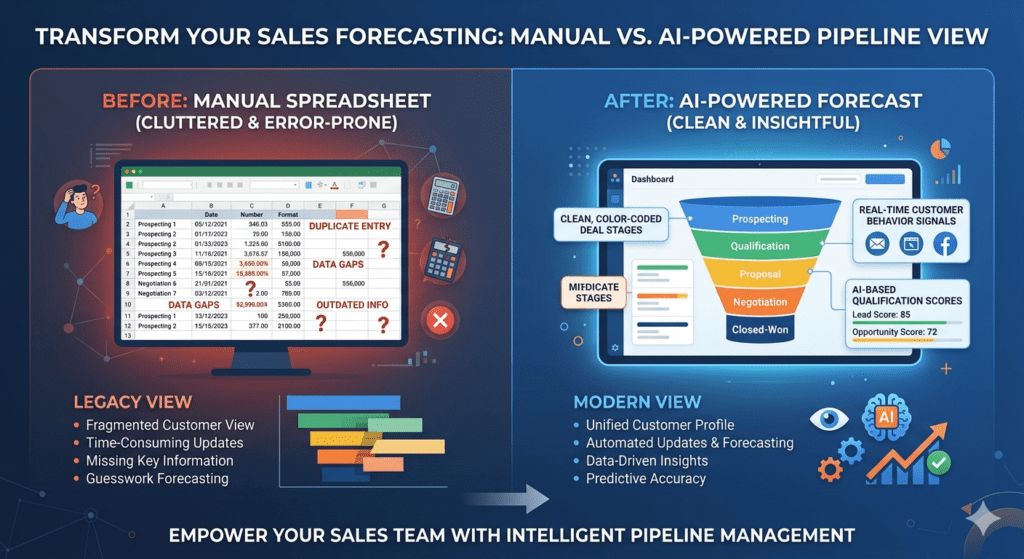
Traditional forecasting relies on CRM data that reps manually update — which means it’s only as accurate as a salesperson’s self-reporting. That’s a significant structural weakness. AI-powered forecasting tools solve this by ingesting objective signals: email reply rates, meeting cadence, contract activity, and even sentiment from call transcripts.
Key difference: AI tools analyse patterns across hundreds of closed deals and apply those patterns to your current pipeline, producing probabilistic forecasts rather than static stage-based estimates.
In practice, teams using AI forecasting tools tend to catch at-risk deals weeks earlier than those relying on the CRM stage alone. That early warning translates directly to better coaching, faster re-engagement, and fewer end-of-quarter surprises.
What to Look for in AI Tools for Sales Forecasting and Pipeline Accuracy
Before diving into the list, it’s worth understanding what separates a genuinely useful forecasting tool from one that just adds complexity.
Integration depth matters most. A tool that only reads your CRM is less valuable than one that pulls from email, calendar, call recordings, and marketing automation simultaneously. The more signal sources, the more accurate the model.
Explainability is often overlooked. You need to understand why a deal is scored high or low — not just receive a number. Tools that show contributing factors (engagement drop-off, champion went dark, competitor mentioned on a call) give your team actionable intelligence.
Real-time updates separate forecasting tools from reporting tools. Static weekly snapshots are better than nothing, but AI forecasting should reflect the live state of your pipeline as deals progress or stall.
Key Insight: The best AI tools for sales forecasting and pipeline accuracy don’t just predict outcomes — they tell you which specific actions will change those outcomes.
Other critical criteria to evaluate:
- Forecast override transparency (can managers see when reps override AI suggestions, and why?)
- Historical accuracy tracking (does the tool show you how accurate its past predictions were?)
- Scenario modeling (what happens to revenue if you close 20% fewer deals this month?)
- Team-level vs. rep-level breakdown visibility
The 15 Best AI Tools for Sales Forecasting
1. Clari — Best Overall for Revenue Operations
Clari is widely regarded as the category leader in AI-powered revenue forecasting. It connects to your CRM, email, calendar, and call data to build a real-time picture of every deal in your pipeline.
What makes it stand out: Clari’s “Revenue Cadence” framework structures forecasting conversations around AI-generated data rather than rep opinions. Its deal inspection view surfaces which opportunities are at risk before your team realizes it.
Best for: Mid-market to enterprise sales teams running complex, multi-stakeholder deals.
Limitation: Clari’s pricing is enterprise-oriented and not suitable for early-stage or small teams.
| Feature | Detail |
|---|---|
| Forecast type | Predictive + scenario modeling |
| CRM integrations | Salesforce, HubSpot, Microsoft Dynamics |
| AI signals | Email activity, calendar, call transcripts |
| Best for | Enterprise revenue teams |
2. Gong — Best for Conversation Intelligence + Forecasting
Gong is best known for its call recording and conversation intelligence capabilities, but its forecasting module is genuinely powerful. Gong analyzes what’s actually being said in sales calls — competitor mentions, pricing discussions, multi-threading — and factors those signals into deal health scores.
What makes it stand out: No other tool connects conversational reality to forecast accuracy as directly as Gong does. If a champion goes silent after a product demo, Gong flags it.
Best for: Teams that conduct significant discovery and demo calls and want their forecast grounded in conversation data.
Limitation: It’s a significant investment, and teams who don’t use it for call recording may not extract full value from the forecasting module alone.
3. Salesforce Einstein — Best for Teams Already on Salesforce
Salesforce Einstein is the native AI layer built into the Salesforce CRM platform. For teams already invested in the Salesforce ecosystem, it’s the most frictionless way to add AI-powered forecasting without introducing a new platform.
What makes it stand out: Einstein uses your existing CRM history to build predictive models. Its “Opportunity Scoring” feature rates deals based on historical patterns unique to your sales process, not generic benchmarks.
Best for: Salesforce-native sales teams wanting AI forecasting without adding external tools.
Limitation: Its predictive accuracy is bounded by your CRM data quality. If your Salesforce hygiene is poor, Einstein inherits those problems.
4. HubSpot Sales Hub with AI Forecasting — Best Free Starting Point
HubSpot’s Sales Hub includes built-in forecasting that has been progressively enhanced with AI-driven insights. The free and Starter tiers give small teams a solid entry point into structured sales forecasting.
What makes it stand out: For teams exploring sales forecasting tools free or low-cost options, HubSpot’s native forecasting removes the need for a separate tool entirely. Its deal scoring and pipeline management are tightly integrated.
Best for: SMBs, startups, and teams already using HubSpot CRM.
Limitation: Advanced AI forecasting features are gated behind higher-tier plans. Free tier forecasting is stage-based, not truly AI-predictive.
5. Chorus.ai (by ZoomInfo) — Best for Conversation-Driven Pipeline Insight
Chorus.ai captures and analyzes every customer-facing conversation — calls, video meetings, emails — and surfaces insights that directly influence forecasting accuracy. Its integration with ZoomInfo gives it an additional layer of firmographic and intent data.
What makes it stand out: Chorus tracks deal momentum by monitoring engagement frequency, response times, and the topics discussed at each stage. Its AI flags deals showing momentum loss before human managers notice.
Best for: Teams wanting conversation intelligence that feeds directly into pipeline health scores.
Limitation: Its forecasting is strongest when used alongside a primary CRM forecasting tool, rather than as a standalone forecast system.
6. People.ai — Best for Revenue Data Automation
People.ai automatically captures all customer-facing activity — emails, meetings, calls — and maps it to CRM records without relying on manual rep logging. This activity data then powers its AI forecasting and pipeline inspection capabilities.
What makes it stand out: People.ai solves the CRM data quality problem at its root. When every interaction is automatically logged and attributed, the AI model forecasting from that data is inherently more reliable.
Best for: Revenue operations teams focused on data completeness and pipeline accuracy.
Limitation: Implementation requires careful data governance setup, especially in large enterprise environments.
7. Aviso AI — Best for Predictive Deal-Level Forecasting
Aviso AI uses a proprietary “WinScore” that evaluates every deal’s likelihood of closing based on CRM signals, engagement activity, and historical patterns. Its forecasting accuracy claims — often cited in its own case studies — are notable for enterprise deal cycles.
What makes it stand out: Aviso’s guided selling recommendations link directly to forecast outcomes. Reps aren’t just told a deal is at risk; they’re told which action to take next.
Best for: Enterprise sales teams with long, complex deal cycles.
Limitation: Smaller teams may find the platform’s depth more than they need, and onboarding can take time.
8. Outreach — Best for Sales Engagement + Forecasting in One Platform
Outreach combines sales engagement (sequences, cadences, outreach automation) with AI-powered forecasting in a single platform. This means your forecast is built from the same system generating your prospecting activity.
What makes it stand out: Outreach’s “Kaia” AI assistant analyzes rep activity, deal engagement, and pipeline data to surface forecast risk in real time. Teams managing high-volume pipelines benefit most from this integrated view.
Best for: High-velocity sales teams that want their engagement and forecasting tools unified.
Limitation: Teams using Outreach primarily for engagement may find the forecasting module underwhelming unless fully implemented alongside its CRM integration.
9. Pipedrive AI — Best Affordable Option for SMBs
Pipedrive has introduced AI-powered features, including deal probability scoring and pipeline performance insights, at price points accessible to small and mid-sized businesses. Its AI sales assistant provides actionable suggestions based on deal history and activity patterns.
What makes it stand out: Pipedrive’s AI features are embedded into an already intuitive, affordable CRM. For teams that don’t need enterprise-grade forecasting depth, it delivers meaningful AI assistance without complexity.
Best for: Small businesses and growing sales teams on a limited budget.
Limitation: Its AI forecasting is less sophisticated than enterprise platforms. It’s excellent for pipeline visibility but less powerful for multi-variable scenario modeling.
10. Zoho CRM with Zia AI — Best Free Tier for AI Forecasting
Zoho CRM’s built-in AI assistant, Zia, offers deal predictions, anomaly detection, and sales trend analysis. The free tier of Zoho CRM makes Zia one of the most accessible sales forecasting tools free options on the market.
What makes it stand out: Zia can analyze your sales patterns and proactively alert you to deals showing stagnation. It also offers voice and chat interfaces, making it genuinely interactive.
Best for: Budget-conscious teams, early-stage startups, and those evaluating AI forecasting before committing to larger platforms.
Limitation: Zia’s AI is less powerful than dedicated forecasting platforms. Its predictions improve significantly only after the system has accumulated substantial historical data.
11. Apollo.io — Best for AI Tools for Sales Forecasting and Qualification
Apollo.io combines a massive B2B contact database with AI-powered engagement scoring, lead qualification, and pipeline analytics. Its strength lies in identifying which prospects in your pipeline are most likely to convert — a critical input to any accurate forecast.
What makes it stand out: Apollo’s AI scoring helps teams qualify pipeline before it enters the forecast, reducing the common problem of inflated pipelines that never close. This makes it one of the stronger AI tools for sales forecasting and qualification.
Best for: SDR-heavy teams that need to qualify pipeline rapidly and feed cleaner data into their forecasting model.
Limitation: Apollo’s forecasting capabilities are weaker than dedicated forecasting platforms. It’s best used as a qualification and top-of-funnel enrichment tool that feeds a primary forecasting system.
12. 6sense — Best for AI Tools for Sales Forecasting and Customer Behavior Analysis
6sense uses AI and intent data to identify which accounts are actively researching your solution — even before they engage with your sales team. This buying intent signal is a powerful input to forecasting because it identifies likely buyers earlier in the cycle.
What makes it stand out: 6sense maps the entire buying committee’s digital behavior, giving revenue teams a complete view of account intent. This makes it one of the most sophisticated AI tools for sales forecasting and customer behavior analysis available.
Best for: Enterprise B2B teams selling to buying committees and running account-based sales motions.
Limitation: 6sense is expensive and best suited for teams with established ABM programs. Its value diminishes if your team lacks the capacity to act on intent signals quickly.
Key Insight: 6sense doesn’t just tell you who might buy — it tells you when they’re most likely to be receptive, which is transformative for pipeline timing and forecast accuracy.
13. Tableau CRM (formerly Einstein Analytics) — Best for Custom Forecasting Dashboards
Tableau CRM, integrated with Salesforce, allows revenue operations teams to build highly customized AI-powered forecasting dashboards. It’s less a plug-and-play forecasting tool and more a powerful analytics environment where you design your own forecast logic.
What makes it stand out: For teams with complex revenue models — multiple product lines, geographies, or revenue streams — Tableau CRM allows forecasting customization that off-the-shelf tools can’t match.
Best for: Large organizations with dedicated RevOps or data analytics resources.
Limitation: It requires technical investment to set up and maintain. Teams without analytics expertise will struggle to extract full value.
14. Freshsales with Freddy AI — Best Mid-Market Option
Freshsales, part of the Freshworks suite, includes Freddy AI — a built-in assistant that provides deal scoring, pipeline insights, and next-step recommendations. It occupies a comfortable middle ground between SMB simplicity and enterprise power.
What makes it stand out: Freddy AI’s deal scoring is trained on your own historical data, making it progressively more accurate the longer you use the platform. Its anomaly detection flags deals that deviate from typical patterns.
Best for: Mid-market sales teams wanting AI forecasting without the complexity or cost of enterprise platforms.
Limitation: Freddy’s AI is less mature than Clari or Gong’s dedicated forecasting engines. It’s strong for directional guidance but not for deep forecast methodology.
15. Pipeliner CRM — Best for Visual AI Forecasting
Pipeliner CRM takes a distinctly visual approach to pipeline management and AI forecasting. Its interface uses visual maps and graph-based deal views to make pipeline health immediately readable — even for sales managers who aren’t data-oriented.
What makes it stand out: Pipeliner’s AI engine generates revenue forecasts and provides “pipeline health scores” displayed in visual formats that are easy to interpret in sales meetings. Its instant dynamic visualization of forecast data is genuinely differentiated.
Best for: Sales managers who want visual clarity in forecasting without spreadsheet complexity.
Limitation: Its AI capabilities are not as deep as enterprise-focused platforms. It’s best for teams that prioritise simplicity and visual pipeline management.
Quick Comparison: Top AI Forecasting Tools at a Glance
| Tool | Best For | Free Tier | AI Forecast Type | Pricing |
|---|---|---|---|---|
| Clari | Enterprise RevOps | ❌ | Predictive + scenario | Enterprise |
| Gong | Conversation intelligence | ❌ | Conversational signals | Enterprise |
| Salesforce Einstein | Salesforce-native teams | ❌ | Opportunity scoring | Included in SF tiers |
| HubSpot Sales Hub | SMBs, free start | ✅ | Stage-based + basic AI | Free–$$$ |
| Zoho CRM (Zia) | Budget teams | ✅ | Deal prediction, anomaly | Free–$$ |
| Apollo.io | Qualification-first teams | ✅ (limited) | Lead scoring | Free–$$ |
| 6sense | ABM, intent data | ❌ | Intent + behavior analysis | Enterprise |
| Pipedrive AI | Growing SMBs | ❌ | Deal probability | $$ |
| Aviso AI | Complex deal cycles | ❌ | WinScore, guided selling | Enterprise |
| Freshsales (Freddy) | Mid-market | ✅ (limited) | Deal scoring, anomaly | Free–$$ |
How AI Tools Improve Sales Forecasting and Pipeline Accuracy
The fundamental mechanism behind AI forecasting improvement is pattern recognition at scale. A human manager reviewing 50 deals can absorb limited signal. An AI system analyzing thousands of historical deals finds patterns no human would detect: the correlation between champion engagement drop-off in week three and deal loss, the relationship between multi-threading depth and close rate, the impact of specific objection language on outcome.
These patterns become predictive models applied to your live pipeline. When a deal exhibits characteristics similar to deals that historically stalled, the AI flags it — often weeks before the human team would notice.
Real-world example: A mid-market SaaS company using Gong alongside Clari reduced late-stage deal slippage by identifying a recurring pattern: deals where the economic buyer stopped attending calls after a security review were 67% more likely to push to the next quarter. Once identified, sales leadership introduced a champion re-engagement play specifically triggered when that pattern emerged.
According to McKinsey’s research on AI in sales, companies that adopt AI-enabled sales processes report significant improvements in lead conversion rates and revenue generated per sales rep — driven directly by better forecasting and prioritization.
If you want to explore more tools and strategies for growing revenue efficiently, Geniostack’s resource hub for sales and AI technology is a strong starting point for teams at any stage.
Trusted AI Tools for Sales Analytics and Forecasting: How to Choose the Right One
Choosing among trusted AI tools for sales analytics and forecasting comes down to three variables: your team size, your existing tech stack, and your forecasting maturity.
Small teams (under 10 reps): Start with HubSpot Sales Hub or Zoho CRM with Zia. Both offer free or low-cost tiers with meaningful AI capabilities. Don’t over-engineer your forecasting before you have enough historical data to train a model effectively.
Mid-market teams (10–100 reps): Freshsales with Freddy AI or Pipedrive AI offer the right balance of capability and simplicity. If you’re running significant outbound, layer Apollo.io on top for qualification signal.
Enterprise teams (100+ reps or complex deal cycles): Clari, Gong, Aviso AI, or 6sense are purpose-built for your environment. The investment is justified when forecast inaccuracy costs millions in misallocated resources or missed quota.
A practical selection framework:
- Audit your current CRM data quality — AI models are only as good as their training data
- Identify your biggest forecasting failure point (inaccurate stage data, at-risk deal blindness, qualification gaps)
- Shortlist tools that solve that specific failure
- Evaluate integration depth with your existing CRM and engagement tools
- Run a pilot with a subset of your pipeline before full deployment
Key Insight: The single biggest mistake teams make when adopting AI forecasting tools is choosing based on feature lists rather than their specific forecasting problem. Define the problem first; then find the tool that solves it.
Sales Forecasting Tools Free: Best No-Cost Options to Start With
Not every team has the budget for enterprise AI forecasting. The good news is that several credible platforms offer free tiers with genuine forecasting value.
HubSpot CRM (Free): Includes basic deal pipeline management and stage-based forecasting. Not AI-predictive, but gives small teams structure and visibility. The Sales Hub Starter plan adds AI-powered deal scoring at an accessible price point.
Zoho CRM (Free tier with Zia): Zia’s AI features are partially available on free and standard Zoho plans. Deal prediction and anomaly detection are accessible without enterprise pricing.
Apollo.io (Free tier): Apollo’s free plan includes limited contact enrichment and engagement scoring — valuable for qualification-focused teams managing small pipelines.
Pipedrive (Trial): Pipedrive offers free trials that include its AI sales assistant, giving teams the opportunity to evaluate AI forecasting before committing.
The honest trade-off with free tools: AI models improve with data volume. Early-stage teams with small historical datasets will see less accurate predictions than mature teams. Free tools are best for getting your team comfortable with structured, data-driven forecasting before investing in a dedicated AI platform.
For a broader look at tools that help sales and marketing teams work smarter, explore the AI tools and automation resources on Geniostack.
What are AI tools for sales forecasting?
How do AI tools improve sales forecasting and pipeline accuracy?
Which AI sales forecasting tools are free?
How do AI tools help with sales forecasting and customer behavior analysis?
What is the best AI tool for sales forecasting and qualification?
Are AI sales forecasting tools worth the investment?
How long does it take for AI forecasting tools to become accurate?
AI tools for sales forecasting have moved from a competitive advantage to an operational necessity for teams serious about revenue predictability. The key takeaways from this guide:
- Match the tool to your problem: Identify your biggest forecasting failure point — inaccurate CRM data, at-risk deal blindness, or qualification gaps — and select the tool built to solve that specific issue.
- Data quality determines AI quality: No AI model produces reliable forecasts from poor CRM hygiene. Clean, consistent data is a prerequisite, not an afterthought.
- Start where you are: Free tools like HubSpot and Zoho CRM with Zia give early-stage teams a legitimate AI foundation without enterprise budgets.
The difference between teams that hit quota consistently and those that perpetually miss is rarely talent — it’s the quality of their forecasting intelligence. AI tools close that gap.
Ready to explore more resources on AI, sales automation, and revenue growth tools? Discover what Geniostack has to offer →